
Hotshot insurance cost per month
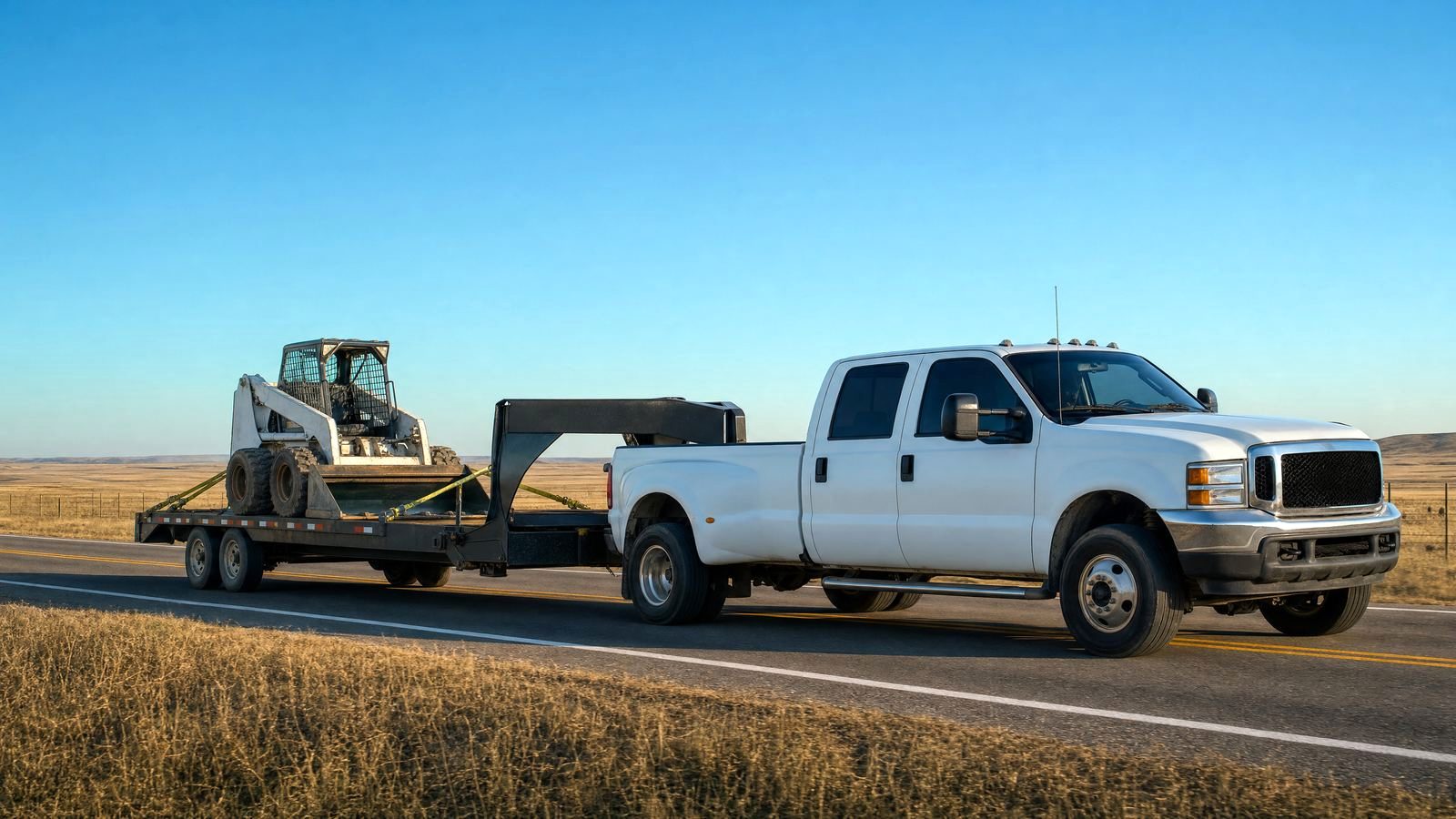
Hotshot insurance is the commercial policy for a pickup that pulls a gooseneck or flatbed trailer for pay.
Hotshot insurance cost by setup
For commercial auto coverage, the average hotshot insurance cost is about $896 a month, or $10,757 over a full year, according to Insureon's quote data. On top of that, general liability adds roughly $32 a month.
How you run moves that number more than anything else, because it decides who carries the main liability policy:
| Your setup | Whose policy pays for crashes you cause | What you buy | What it costs a month |
|---|---|---|---|
| Your own trucking business, MC number already active | Yours | Liability for injuries and damage you cause: $750,000 at 10,001 lbs or more, $300,000 below. Most brokers ask $1,000,000 plus $100,000 cargo. Cover for your own truck is extra. | $665 to $1,165 with a clean record (Trucking Insurance Services); the middle quote at Insureon is about $896 |
| Your own trucking business, brand new MC number | Yours | The same coverage. Your insurer has 20 days to send proof of it to the FMCSA once your application is published. | $1,000 to $1,800 in the first two years (Trucker Path Insurance), because insurers have no claims record for you yet. Add the $300 OP-1 application fee and $55 a year for UCR registration |
| Leased on: you drive under another trucking company’s MC number | That company’s, while you haul for it | Non-trucking liability for driving off the job, and cover for your own truck | Usually less than running your own business, says Progressive; buying these yourself often costs less than buying them through the company (Progressive) |
If you have your own authority, you run your own trucking business with an MC number, the federal permit to haul for pay across state lines, issued by the FMCSA, the federal trucking agency. If you are leased on, you drive under another trucking company’s MC number, and its policy covers most crash claims.
What sets your price for a hotshot setup?
What you actually pay comes down to your truck and trailer, your record behind the wheel, your location, and whether you haul across state lines. What you pay reflects the coverage your operation needs and how risky the insurer thinks your business is. Every commercial vehicle must carry vehicle liability, Progressive notes. When you operate under your own authority and cross state lines, the federal minimum varies with your truck and what you haul:
| What you haul | Least liability coverage the law requires |
|---|---|
| General freight, truck and trailer rated under 10,001 lbs | $300,000 |
| General freight, truck and trailer rated 10,001 lbs or more | $750,000 |
| Hazardous material that needs warning signs (placards), including oil and hazardous waste, 10,001 lbs or more | $1,000,000 |
| Explosives, poison gas, radioactive material, or hazardous material carried in bulk tanks | $5,000,000 |
Each figure is a combined single limit: your policy has to cover at least this much for one crash, with injuries and property damage counted together.
Brokers often ask for more than the legal minimum. TQL, C.H. Robinson, Amazon Relay and Uber Freight each ask for $1,000,000 in auto liability and $100,000 in cargo coverage, per their carrier pages like TQL's, so check what yours wants before you buy. Federal cargo insurance rules apply only to household goods movers, not general freight carriers, J.B. Hunt explains, but customers may still require you to carry cargo coverage.
Insurers also look at:
- The type and size of your truck, and the trailer you pull: bumper pull, gooseneck (hitched in the truck bed) or flatbed
- What you haul, how far, and how often
- Whether you cross state lines or stay inside one state
- Your driving record: even one small speeding ticket can raise the price a lot
- Your safety rating, the grade the FMCSA gives your business after a safety check, which can change the price a lot
- Your city and state: busy areas with more crashes cost more
- How much your business earns in a year and how many people work for you
Commercial truck insurance costs across the industry
Progressive shares national monthly averages for trucking as a whole. For for-hire transport truckers it puts the number at $926 a month, while for-hire specialty truckers average $734 a month, according to Progressive Commercial.
Coverage is just one expense of keeping a truck on the road. The American Transportation Research Institute calculated that running a truck in 2025 cost an average of $2.336 per mile, a 3.4 percent jump over the prior year.
The Insureon numbers are medians, meaning the middle price among hotshot businesses that requested quotes through Insureon. They are not a price every driver can expect.
Finding the cheapest commercial truck insurance
Since quotes are built around your specific details, the best savings come from adjusting your policy and setup. Insureon suggests 3 ways to lower what you pay:
- Go with lower limits, provided they still satisfy the law and your brokers' requirements
- Take a higher deductible, the amount you pay out of pocket before insurance covers a claim
- Drop add-ons like comprehensive coverage
Keep in mind that physical damage coverage is generally required while you still have a loan or lease on the truck, so dropping it may not be an option.
Running leased onto a motor carrier tends to cost less than holding your own authority, says Progressive. Under a lease, the carrier generally handles primary liability while you're hauling for it. Ask what the carrier's policy covers while you're hauling for it and whether you need non-trucking liability for off-duty driving.
Newer trucks equipped with advanced safety features can sometimes be cheaper to cover. Progressive also gives discounts when you bundle policies, pay in full, or insure your personal vehicles through them.
What does each part of your policy cover?
You may need coverage beyond commercial auto, depending on what you haul and what your customers require.
| Coverage | What it pays for | Usual cost or limit |
|---|---|---|
| Commercial auto | Commercial auto covers legal fees, medical bills, and repairs when your truck hurts someone or damages property. With physical damage cover added, it can also pay for theft, vandalism, and weather damage to your own truck. | Most of what you pay |
| General liability | Handles lawsuits from other people that are not about your driving. The typical Insureon policy carries a $1 million limit for each occurrence and a $2 million limit in total. | Median $32 a month |
| Motor truck cargo | Protects your customer's freight and also pays their shipping costs if a load never shows up. | Brokers usually ask $100,000 |
| Rental reimbursement with downtime | May pay for lost income in some cases. | Optional |
| Trailer interchange | Covers trailers you don't own, but only under a formal interchange agreement. | Needed with an interchange agreement |
A per-occurrence limit caps what gets paid for a single incident. An aggregate limit caps the total paid across every claim in the policy period, which most often runs 1 year.
You can also combine general liability with commercial property inside a business owner's policy, which extends protection to your office and other business property.
Paying in full and startup costs
If you can afford to, paying the whole policy up front may save you money. Most Progressive customers cut costs by 10% or more when they pay in full, according to Progressive.
Coverage also feeds into startup expenses. A new operating authority requires a one-time FMCSA fee of $300, while yearly registration with the Unified Carrier Registration plan for 2027 runs $55 for 0 to 2 trucks. Once your authority application is published, the insurer gets 20 days to file proof of coverage, otherwise the application gets dismissed. So it helps to line up an insurer early.
| Startup step | Who does it | Cost | When |
|---|---|---|---|
| OP-1: the application for your MC number | You | $300, one time | First |
| BOC-3: names process agents, people in each state who accept legal papers for you | A process agent company, for you | Set by that company | Before your MC number goes active |
| BMC-91X: your insurer’s proof of your liability coverage, sent to the FMCSA | Your insurer | Part of your policy price | Within 20 days after the FMCSA publishes your application |
| MCS-90: an extra page on your policy that pays people hurt in a crash up to the legal minimum | Your insurer | Part of your policy price | When the policy is written |
| UCR: a yearly registration for trucking businesses that cross state lines | You | $55 a year for 0 to 2 trucks | Every year |
How much does non CDL hotshot insurance cost?
Non-CDL hotshot cover is not priced higher than CDL cover, says Trucking Insurance Services: a typical non-CDL rig under 26,001 pounds runs $1,000 to $1,585 a month in its first year, and the record and the state move the price, not the license. Many hotshot drivers use heavy-duty pickups like duallys rated under 26,001 pounds.
You need a CDL when a single truck is rated 26,001 pounds or more, or when truck and trailer together are rated 26,001 pounds or more and the trailer alone is rated over 10,000 pounds, under 49 CFR 383.91. Certain freight companies insist on a CDL even where the law doesn't, which can shrink the pool of loads available to you.
Holding a CDL may also affect workers' compensation. Some insurers give a workers' comp discount to hotshotters with a CDL that drivers without one don't get.
Common questions
Which insurance do I need for hotshot work?
If you run under your own authority across state lines, you'll need liability insurance on file with the federal trucking regulator, the FMCSA. Your insurer handles that paperwork for you. You'll also need a process agent, a company that accepts legal papers for you, to file a form listing every state you work in. If your hauling stays inside 1 state, the state sets the minimum, and some states just adopt the federal rules.
Do I need workers' comp for a hotshot business?
That depends on your state and whether you have staff. California and New York require it as soon as you have even 1 employee, full-time or part-time. Florida requires it at 4 or more employees, while Texas leaves it optional. Cost mostly depends on your headcount and how risky the work is.
Does my state change what I pay?
The averages here are national, so they can't tell you what your state costs. Where you live and drive does affect your rate, so treat the numbers as a rough starting point.
Sources
- Hotshot insurance cost (truckinginsuranceservices.com)
- How much is hotshot insurance (truckerpathinsurance.com)
- Hotshot Insurance Costs (Insureon)
- What operating authority costs (FMCSA)
- Commercial Truck Insurance Cost (Progressive Commercial)
- Owner Operator Insurance (Progressive Commercial)
- Hotshot Trucking Insurance (Progressive Commercial)
- Security for the protection of the public: Minimum limits (49 CFR 387.303)
Related
Get your rig priced by an agent
Hotshot Insure does not sell insurance. An independent agent who places hotshot and small truck policies prices your rig by phone, or you can send your details.