
Dump truck insurance
Dump truck insurance is a type of commercial truck coverage built for businesses that move materials like dirt, sand, and gravel, and it covers the liabilities and damage that can occur while hauling. The coverage you need comes down to your routes, your truck's weight, and your cargo.
- If you haul non-hazardous loads for hire across state lines in a vehicle rated at 10,001 lbs or more, the federal liability minimum is $750,000.
- If you haul property for hire across state lines and every vehicle in your fleet is rated under 10,001 lbs, the federal liability minimum is $300,000.
- If your hauling never leaves your home state, the state decides how much coverage you must carry.
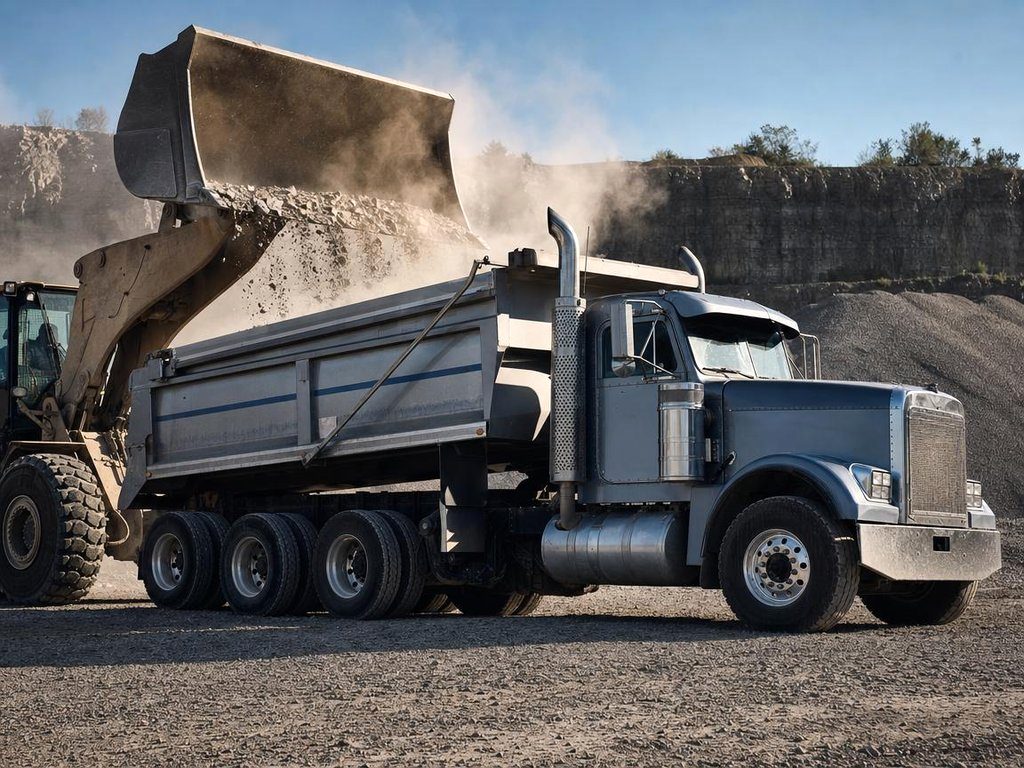
Who needs dump truck insurance?
It applies to owner-operators and for-hire truckers, whether their work stays local or takes them on the road. For-hire means you get paid by other people or businesses to move their materials.
A few kinds of businesses tend to rely on it:
- Construction firms
- Landscaping businesses
- Waste management companies
- Distributors and wholesalers
- Manufacturers
Sometimes the liability coverage comes from the for-hire trucker's employer. Since personal auto insurance usually won't cover business use, you may need a commercial policy instead.
Coverage requirements
Dump truck jobs tend to be local, like moving loads between job sites within one state. When that's the case, the rules usually come from your home state.
Crossing state lines means following FMCSA guidelines. The FMCSA is the federal agency in charge of trucking regulation, and its minimums vary with truck weight and cargo type.
| For-hire work that crosses state lines | Liability minimum |
|---|---|
| Non-hazardous cargo, all vehicles in the fleet under 10,001 lbs | $300,000 |
| Non-hazardous cargo, vehicle rated at 10,001 lbs or above | $750,000 |
| Oil, hazardous waste, or hazardous loads that need warning placards, at 10,001 lbs or above | $1,000,000 |
| Bulk-tank hazardous substances, radioactive materials, poison gas, or explosives | $5,000,000 |
These figures come from 49 CFR 387.9, 49 CFR 387.303, and FMCSA.
Proof of liability insurance goes to FMCSA from your insurer on Form BMC-91 or BMC-91X. Once your application for operating authority (your MC number) is published, the insurance company gets a 20-day window to submit that proof before the application is thrown out. Trucks rated 10,001 lbs or more that run interstate also need a USDOT number.
If you're leased on to a carrier, their insurance filing covers you while you're on a dispatched job. You'd still carry your own coverage for driving off the job, often called non-trucking liability or bobtail, and for damage to your truck.
What it costs
There's no single price we can quote for your truck, since insurers weigh several things. One is whether you operate under your own USDOT authority or lease on with a motor carrier. Other factors that commonly come into play:
- Where you're based
- How much coverage you need
- Whether you own the truck
- What you haul
- Safety practices
- Your driving record
To give you a rough idea, Progressive Commercial puts national average monthly truck insurance costs at $734 for specialty truckers, climbing as high as $926 a month for transport truckers, and the company has discount programs available as well.
New authority brings extra costs too. FMCSA charges a one-time $300 fee per operating authority. The UCR, an annual federal registration fee, comes to $55 in 2027 for a carrier with up to two power units.
Extra protection past basic liability
Standard commercial auto insurance may leave gaps for the situations dump trucks run into, which makes a policy designed for dump trucks a smart thing to ask your agent about.
- If the driver or a passenger is injured in a crash, medical payments coverage helps take care of the medical bills.
- When a driver without enough insurance causes an accident, uninsured/underinsured motorist coverage helps cover the harm done to you, anyone riding with you, and your truck.
- Workers' compensation shields employers from related lawsuits, and most states require it.
Frequently asked questions
What coverage does a dump truck need?
Start with commercial liability that satisfies your state or federal rule. You can also ask about physical damage, medical payments, and uninsured/underinsured motorist coverage for protection beyond liability. If you employ workers, most states require workers' compensation too.
Do brokers expect coverage above the federal minimum?
In many cases, yes. Big brokers like C.H. Robinson, TQL, and Uber Freight typically want carriers to carry a million dollars of auto liability plus $100,000 in cargo protection. The government doesn't require cargo insurance for freight carriers, so that $100,000 is the broker's own rule, and our phone line reaches an independent insurance agent who writes trucks and can help you sort out what fits.
Who handles the filings?
Your insurer usually files proof of insurance with FMCSA for you, and Progressive, for example, takes care of the state and federal paperwork when you purchase a dump truck policy through them while applying for your authority. The BOC-3 form, the one that lists your process agents, must be filed by a process agent acting for you.
Sources
Related
Get your rig priced by an agent
Hotshot Insure does not sell insurance. An independent agent who places hotshot and small truck policies prices your rig by phone, or you can send your details.