
Semi truck insurance
Liability is the part of semi truck insurance the law requires before you can drive. It pays for the injuries and damage your rig causes others. For-hire carriers moving ordinary freight between states need at least $750,000 in liability coverage when the vehicle is rated 10,001 pounds or more. At one major insurer, typical monthly bills fall between $734 and $926.
- The federal liability floor for most interstate freight: $750,000
- The liability amount most brokers want to see: $1,000,000
- Progressive Commercial's typical monthly price: $734 to $926
- Getting your own operating authority costs a one-time $300 FMCSA fee
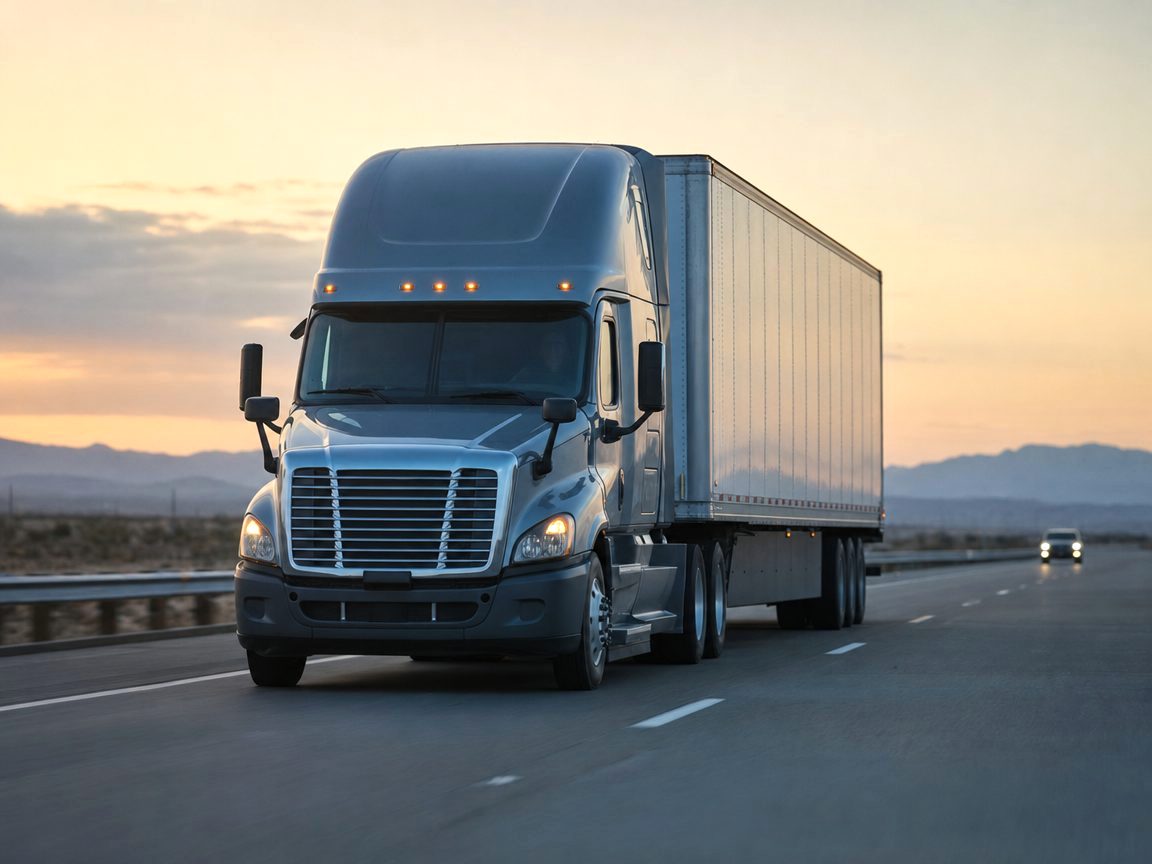
What an 18 wheeler insurance policy has to cover
Start with liability. According to Progressive Commercial, it's the basic coverage any truck operator must have to stay legal on the road. It splits into 2 parts, one for property damage and one for bodily injury, with a separate required amount for each.
- Property damage liability covers the cost when you damage someone else's property in a crash that's your fault. That includes other vehicles, along with property like mailboxes, garage doors, and storefronts.
- Bodily injury liability takes care of medical bills, rehabilitation, and lost wages for people you hurt in an accident you caused. It also handles legal fees and settlements if someone sues you.
A for-hire carrier is any driver or business that gets paid to move freight owned by somebody else. For-hire truckers operating under their own authority have to carry bodily injury coverage. Authority means the federal go-ahead to run your own trucking company and book paying loads.
Federal liability minimums by load
How much you have to carry comes down to the truck's weight rating and the freight you're hauling. These limits are set by federal rules and the FMCSA.
| Carrier and load | Minimum liability |
|---|---|
| For-hire, fleets made up only of trucks under the 10,001-pound rating | $300,000 |
| For-hire, regular freight crossing state lines in a vehicle rated at least 10,001 lbs | $750,000 |
| For-hire, placarded hazmat, oil, or hazardous waste in a vehicle of 10,001 lbs and up | $1,000,000 |
| Private or for-hire, carrying explosives, poison gas, or radioactive materials, or hauling hazardous substances in bulk tanks | $5,000,000 |
Hauling only within a single state means that state's minimum applies. Your insurer will often file a Form E with the state as proof of coverage.
Coverage for your own truck
Liability covers what happens to other people, not to your truck. Physical damage insurance bundles 3 kinds of protection for your own semi:
- Collision covers crash damage, even in single-vehicle accidents like a rollover.
- Comprehensive pays for damage from the usual causes that aren't crashes.
- Fire and theft also handles common non-crash damage, though its specifics aren't the same as comprehensive.
Coverage for cargo, trailers, and downtime
The freight in your trailer, not the rig itself, is what motor truck cargo insurance protects. It can pay costs when a shipment gets damaged or goes missing in a covered event. Spoilage from temperature swings isn't covered by every cargo policy, so reefer drivers should request refrigeration breakdown coverage.
Trailer interchange covers a trailer you're pulling that belongs to someone else, working a lot like collision and comprehensive. Trailer-owning clients frequently insist on it.
Rental reimbursement with downtime covers the cost of a substitute truck when yours is damaged in a covered event. When there's no replacement truck available, it can help replace the income you lose while sidelined.
Semi truck insurance cost
The average monthly cost at Progressive Commercial for commercial truck insurance runs $734 to $926, varying by the kind of for-hire trucking you do. What you actually pay depends on your home base, which coverages you pick, your limits, your annual mileage, and how risky your line of work is.
For a quote, have ready the truck's make and model, your driver list, and your usual distance from home. You can get a policy quote from an insurance agent once you gather 3 basic details about your operation. According to Progressive Commercial, getting a semi truck and trailer insurance quote can take as little as 8 minutes (once you have your information in front of you).
How does the cost compare across trucker types?
The numbers below reflect national averages for commercial auto insurance, meaning your price may land above or below them.
| Trucker type | Monthly average | Source |
|---|---|---|
| Specialty trucker (for-hire) | $734 | Progressive Commercial |
| Hotshot operator | $896 (about $10,757 annually) | Insureon |
| Transport trucker (for-hire) | $926 | Progressive Commercial |
Insurance for owner operators
Your needs hinge on whether you operate under your own authority or a carrier's.
Running under your own authority
You don't send proof of insurance yourself, because your insurer submits it to the FMCSA using Form BMC-91 or BMC-91X. Your policy must also include the MCS-90, a federal add-on to your liability policy that the FMCSA requires. Deadlines count here. After your authority application gets published, your insurer has 20 days to file, otherwise the application gets dismissed.
More costs and filings tied to having your own authority:
- Operating authority: one-time $300 fee
- UCR registration (2027): $55 if you run 0 to 2 trucks
- BOC-3 form, which names your process agents: a process agent files it, listing every state where you operate
- Protest period: 10 days once the application is published
What do brokers ask for?
J.B. Hunt notes the $750,000 federal minimum, but plenty of brokers expect more before they'll offer you loads.
| Broker | Auto liability | Cargo coverage |
|---|---|---|
 Amazon Relay | $1,000,000 each occurrence | $100,000 in cargo coverage |
 Uber Freight | $1,000,000 | $100,000 |
 TQL | $1,000,000 | $100,000 |
 C.H. Robinson | $1,000,000 | $100,000 |
Leased on to a carrier
Leasing on means putting your truck under a carrier's control and running on its authority. By law, the lease must give that carrier complete possession and use of the truck for as long as the lease lasts. While you're under the carrier's dispatch, its filing covers you. On your end, you still carry non-trucking liability, also called bobtail, plus physical damage on the truck itself.
Frequently asked questions
Can I insure a semi for personal use?
Bobtail coverage, formally called non-trucking liability, helps pay for the injuries and damage your rig causes others while you're using your semi for personal rather than business reasons. When you're hauling for pay, you need a commercial policy, because personal auto insurance usually doesn't cover business use.
Is cargo insurance required by law?
Freight carriers aren't required by federal law to buy cargo insurance. The only federal requirement applies to household goods movers. Even so, most big brokers want to see $100,000 of cargo coverage.
What does general liability cost for a trucking business?
General liability costs far less than commercial auto coverage: hotshot operations average about $32 monthly.
Do I need workers' compensation?
If you have employees, most states require workers' compensation. It also shields the business if an employee sues over a work injury.
Sources
- Financial responsibility, minimum levels (49 CFR 387.9)
- Semi Truck and Trailer Insurance (Progressive Commercial)
- Insurance filing requirements (FMCSA)
- Commercial Truck Insurance Cost (Progressive Commercial)
- Hotshot Insurance Costs (Insureon)
- Form MCS-90 endorsement (FMCSA)
- What operating authority costs (FMCSA)
- UCR fee brackets (UCR Plan)
Related
Get your rig priced by an agent
Hotshot Insure does not sell insurance. An independent agent who places hotshot and small truck policies prices your rig by phone, or you can send your details.