
Trucking insurance in Colorado
To get plates at the county registration counter, you need a complying policy with auto liability of at least 25/50/15.
Monthly cost, national figures
$665 to $1,165 a month for an established hotshot with a clean record (Trucking Insurance Services)
$1,000 to $1,800 in the first two years of a new MC number (Trucker Path Insurance)
What moves the priceBroker ask
$1,000,000 of auto liability and $100,000 of cargo cover, more than the law asks
Broker limits tableOwn MC number
The OP-1 application costs $300, you name a BOC-3 process agent, UCR starts at $55 a year, and your insurer files the BMC-91X within 20 days of FMCSA Register publication.
New authority checklistThat counter is where trucking insurance Colorado rules begin. Hauling only within the state puts you under the Colorado State Patrol Motor Carrier Safety Section once your operation reaches 16,001 lbs. Hauling for pay across state lines calls for liability of $300,000 to $5,000,000, with proof submitted on Form BMC-91 or BMC-91X.
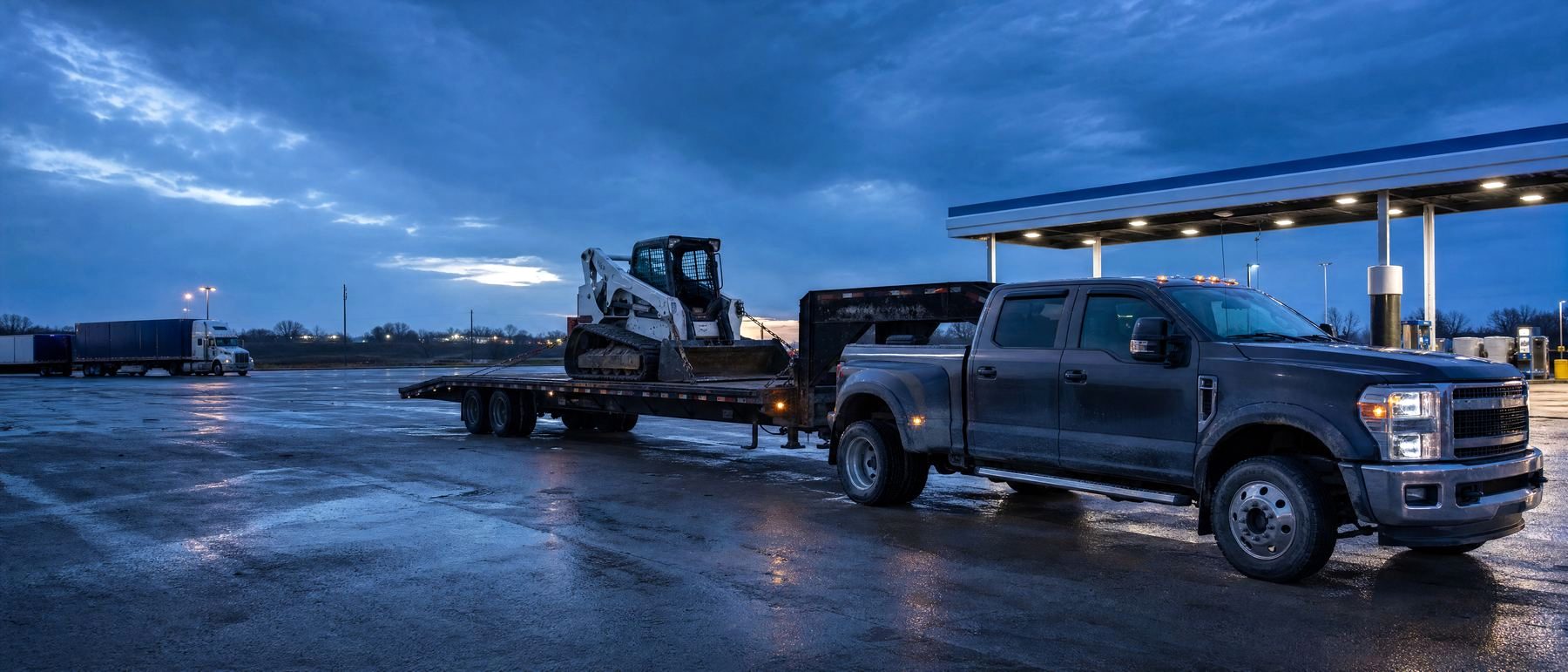
Colorado intrastate trucking insurance requirements and vehicle registration
Larimer County notes that CRS 42-3-105(1)(d)(I) blocks vehicle registration in the state without coverage. You must show an insurance policy that complies or a certificate of self-insurance. If you cause a crash, auto liability is the coverage that pays for other people's injuries and property damage. Colorado's basic auto liability minimum is 25/50/15. That means at least $25,000 when 1 person suffers bodily injury, and $50,000 for all persons injured in 1 accident.
Each Colorado auto policy carries $5,000 in medical payments coverage, which you may reject. It also carries uninsured and underinsured motorist coverage, which you may reject in writing, per the Colorado Division of Insurance. Since basic state auto limits rarely satisfy shippers and rarely cover a heavy work truck, an insurance agent writing commercial truck policies helps you set up proper limits ahead of your county clerk visit.
Who needs Colorado commercial truck insurance and a USDOT number?
Safe operation of commercial vehicles and their operators statewide falls to the Colorado State Patrol Motor Carrier Safety Section. When your pickups and drop-offs stay within Colorado and never cross a state line, that's intrastate commerce. A USDOT number is required for both intrastate and interstate carriers; you register on the FMCSA website (in-state DOT numbers can be requested through the Colorado State Patrol site).
Federal safety rule FMCSR Part 390 was adopted by Colorado, with modifications for in-state carriers. Colorado's weight thresholds for regulating mid-size trucks and tow vehicles sit below the federal ones. So an early conversation with an agent who handles commercial truck coverage helps you line up your policy and your safety registration. In Colorado intrastate commerce, a vehicle is considered a commercial motor vehicle when it meets any of the following:
- One vehicle or a combination whose GVWR or GCWR is at least 16,001 lbs, the maximum safe weight rating the manufacturer sets.
- Tow and car-hauling vehicles count at any weight.
- Vehicles that haul placarded hazardous materials, meaning dangerous loads that must carry warning signs on the outside of the vehicle.
In-state carrier truck markings and safety records
The Colorado State Patrol says intrastate-only carriers in Colorado must mark their vehicles with the USDOT number followed by the suffix CO. Combinations in the 16,001 to 26,000 lbs range that haul no placarded hazmat and carry under 16 passengers have another marking choice. Provided the power unit's GVWR stays at 16,000 lbs or below, marking may go on the trailer rather than the truck.
Every USDOT holder has to submit a biennial update once every 2 years, even when nothing has changed. After any accident you're involved in, an accident register must be kept for 3 years following each crash. An agent familiar with Colorado pickup-and-trailer rules makes sure your policy accurately lists your power unit and your trailer.
Federal filings and limits for Colorado trucking insurance
Haul property for pay across state lines, and federal liability minimums kick in. Your insurer must then file proof with the FMCSA using Form BMC-91, BMC-91X, or a BMC-82 bond. General freight carriers hauling for hire need at least $750,000 in liability when their vehicles have a rating of 10,001 lbs or more. Fleets where every vehicle comes in under 10,001 lbs need no less than $300,000.
Plenty of new carriers take loads from brokers that demand more than the legal minimum. C.H. Robinson, for instance, wants $1,000,000 in auto liability plus $100,000 in cargo liability from carriers. Agents whose daily work is federal truck filings can post your BMC-91X and arrange the limits freight brokers expect.
| Operation and cargo type | Vehicle weight rating | Minimum liability limit |
|---|---|---|
| Colorado basic auto minimum | Any registered vehicle | 25/50/15 (bodily injury: $25,000 a person, $50,000 an accident) |
| Interstate for-hire non-hazardous property | Fleet with only vehicles under 10,001 lbs | $300,000 |
| Interstate for-hire non-hazardous property | 10,001 lbs or more | $750,000 |
| Interstate for-hire oil, hazardous waste, or placarded hazmat | Any weight | $1,000,000 |
| Explosives, poison gas, bulk hazardous substances, or radioactive materials moved interstate, for-hire or private | Any weight | $5,000,000 |
 C.H. Robinson broker requirement | Any commercial truck | $1,000,000 auto liability and $100,000 cargo |
Questions people ask
Can I register my truck in Colorado with an out-of-state policy or by self-insuring?
Yes. Boulder County notes that an out-of-state insurance policy works for registering a vehicle in Colorado, as long as you show it meets Colorado's minimum coverage standards. The Colorado General Assembly also notes that someone who registers more than 25 vehicles may be eligible to self-insure in the state.
Do Colorado commercial vehicle rules apply to farm trucks?
Colorado's agriculture exemption keeps a vehicle or combination at 26,000 lbs or below from counting as a commercial vehicle. The other conditions the state lists still apply. You get this exemption only if the vehicle is used solely for agricultural operations.
When are commercial trucks required to carry tire chains in Colorado?
From September 1 to May 31, commercial truckers traveling I-70 between Morrison and Dotsero must carry chains under Colorado law. Chains must be on the truck any time you drive that section of I-70 during that period.
Sources
- General Regulations (FMCSR Part 390) (csp.colorado.gov)
- Financial responsibility, minimum levels (49 CFR 387.9)
- Insurance filing requirements (FMCSA)
- Auto Insurance (doi.colorado.gov)
- Larimer County vehicle insurance (larimer.gov)
- Commercial Motor Vehicle Information (codot.gov)
- Carrier Resources: FAQs (C.H. Robinson)
- Mandatory Automobile Insurance in Colorado (content.leg.colorado.gov)
Related
Insuring a truck in Colorado
A trucking agent who places policies in Colorado can quote it by phone, or you can send your details.