
Trucking insurance in Wisconsin
For a for-hire carrier, the trucking insurance Wisconsin requires starts with $300,000 in liability coverage for lighter vehicles and rises to $750,000 for trucks over 10,000 pounds.
Monthly cost, national figures
$665 to $1,165 a month for an established hotshot with a clean record (Trucking Insurance Services)
$1,000 to $1,800 in the first two years of a new MC number (Trucker Path Insurance)
What moves the priceBroker ask
$1,000,000 of auto liability and $100,000 of cargo cover, more than the law asks
Broker limits tableOwn MC number
The OP-1 application costs $300, you name a BOC-3 process agent, UCR starts at $55 a year, and your insurer files the BMC-91X within 20 days of FMCSA Register publication.
New authority checklistPlates, trip permits, and operating authority all require your insurer to file proof of coverage with the state first. An agent who writes commercial truck policies helps you set up these state filings correctly the first time.
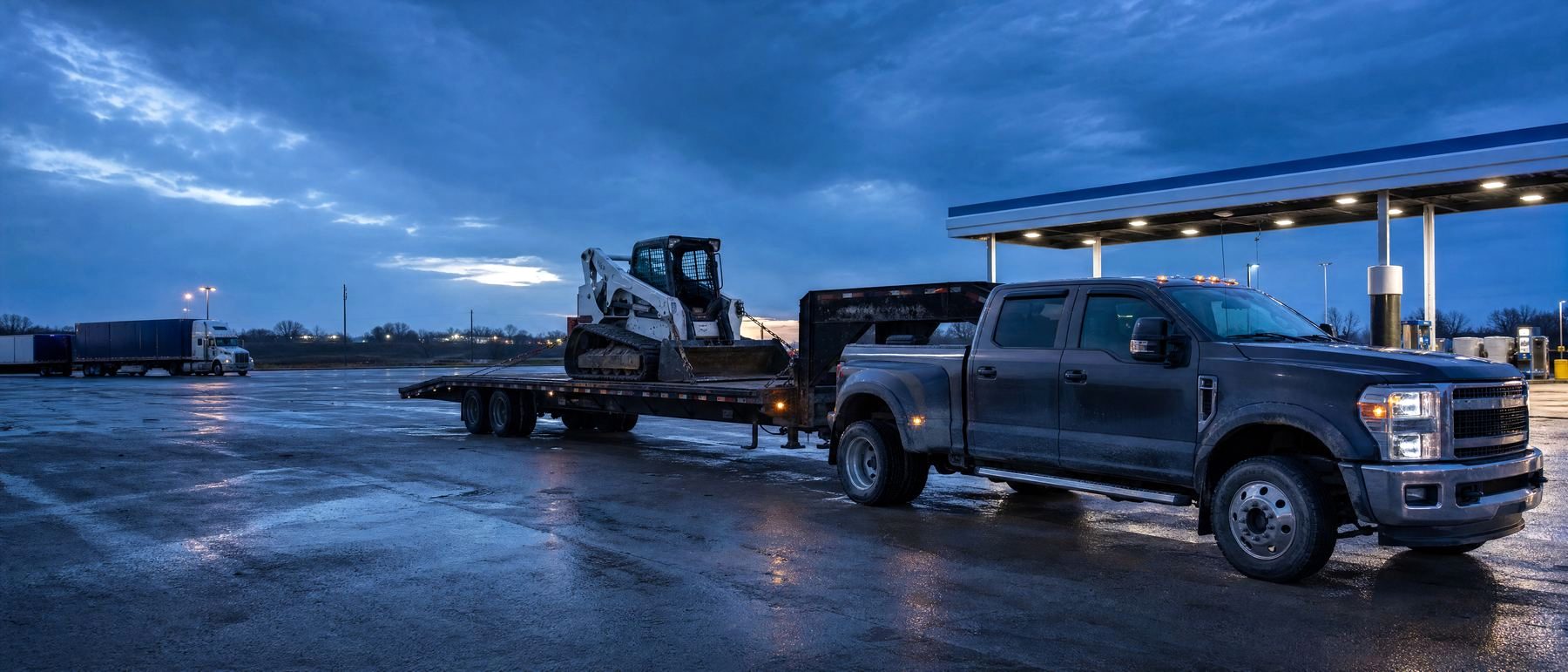
Wisconsin intrastate trucking insurance requirements
For-hire carriers must give the Wisconsin Department of Transportation proof of liability coverage first; only then can they drive on state highways. If you're paid to move someone else's freight, you're a for-hire carrier; intrastate means all pickups and drop-offs happen inside Wisconsin. For trucks with a gross weight over 10,000 pounds, at least $750,000 in coverage must be on file with WisDOT. A vehicle of 10,000 pounds or less needs $300,000, unless it hauls listed hazardous materials, in which case the federal minimums take over.
A combined single limit is 1 flat pool of money covering all injuries and property damage from a crash, and WisDOT filings must use it. WisDOT may require blanket filings, and split-limit, scheduled, or restricted blanket filings are allowed only in narrow state exceptions. For intrastate carriers moving certain hazardous materials, the trigger is a truck rating that reaches 10,000 pounds. Coverage then must be filed with the federal government instead (even if the freight is only your company's). A talk with a truck insurance agent helps make sure your policy follows the combined single limit format WisDOT accepts.
| Operation and cargo | Vehicle weight | Minimum liability | Filing form |
|---|---|---|---|
| Wisconsin intrastate general freight | 10,000 lbs or less | $300,000 | Form E |
| Wisconsin intrastate general freight | Over 10,000 lbs | $750,000 | Form E |
| Interstate non-hazardous freight | Under 10,001 lbs | $300,000 | BMC-91 or BMC-91X |
| Interstate non-hazardous freight | 10,001 lbs or more | $750,000 | BMC-91 or BMC-91X |
| Certain hazardous materials, oil, or waste | 10,000 lbs or more | $1,000,000 | BMC-91 or BMC-91X |
| Explosives, poison gas, radioactive, or bulk hazmat | 10,000 lbs or more | $5,000,000 | BMC-91 or BMC-91X |
Filing Wisconsin trucking insurance for LC authority and plates
The Wisconsin DMV must receive a Form E insurance certificate from your insurer before you can register the vehicle, get trip permits, or obtain Wisconsin operating authority. Operating authority means the government allows you to haul, for pay, property that belongs to other people. Form MV2843 is the application, and the letters LC begin Wisconsin intrastate property authority numbers.
Following the state's USDOT rules is also required before WisDOT approves your plates and authority. Your paperwork gets checked in advance by an agent who regularly files Form E certificates, which keeps a clerical mistake from holding up your registration.
- Match the names letter for letter: A Wisconsin authority number requires the insurance name and the registered owner's name to match exactly.
- Free USDOT number: every carrier, intrastate or interstate, with vehicles rated at least 10,001 pounds must obtain a USDOT number in the Unified Registration System. The cost is $0, and Wisconsin keeps registration on hold pending that number.
- Update every 2 years: the biennial MCS-150 update is due every 2 years, and you must file it so your USDOT registration stays active.
- Stop at open scales: in Wisconsin, trucks over 10,000 pounds must pull into any Safety and Weight Enforcement Facility that's open.
When does Wisconsin commercial truck insurance follow federal rules?
Once you cross a state line, you're under the Federal Motor Carrier Safety Administration, the agency that issues interstate authority. Wisconsin's intrastate filing rule is already met when a current FMCSA filing uses Form BMC-91, Form BMC-91X, or a BMC-82 bond. No second filing is needed. Unified Carrier Registration fees are also due every calendar year from interstate carriers, set by the number of vehicles they run across state lines.
A vehicle rated 10,001 pounds or more carries a $750,000 federal liability minimum; a fleet with only vehicles under 10,001 pounds carries $300,000 (though major brokers such as C.H. Robinson require $1,000,000 of auto liability and $100,000 of cargo coverage). Have a truck insurance agent price the $750,000 legal minimum alongside the $1,000,000 broker standard so you can compare before you buy.
Uninsured motorist rules and state auto minimums
Every policy must also meet Wisconsin's basic auto liability minimums: $25,000 if 1 person is injured or killed and $50,000 if more than 1 person is. If you operate a vehicle without the required insurance in Wisconsin, the fine can be up to $500.
For bodily injury, Wisconsin also requires at least $25,000/$50,000 in uninsured motorist coverage. Buying underinsured motorist coverage is your choice; if you buy it, the limits can't be lower than $50,000 for each person or $100,000 for each accident. A commercial truck agent makes sure your truck policy includes these state injury coverages properly.
Questions people ask
In Wisconsin, does my trailer need separate proof of insurance?
No, trailers and semi-trailers don't need proof of insurance in Wisconsin. The truck doing the pulling is covered by your state liability filing; if you want the trailer itself covered for physical damage, a trucking insurance agent can still help.
Could a shipper's contract in Wisconsin force me to pay for their own negligence?
That isn't allowed. Wisconsin law stops a motor carrier transportation contract from making you defend, indemnify, or hold harmless the shipper when the fault is the shipper's own. A clause that tries to move their fault onto you has no legal effect.
Can a carrier ever waive WisDOT's insurance filing requirement?
It can. WisDOT may exempt a carrier if, after a written application, it finds the company can cover all crash damages on its own. Nearly every small carrier has an insurance agent file a Form E rather than self-insure.
Sources
- Motor carrier insurance (wisconsindot.gov)
- Operating authority (wisconsindot.gov)
- Wisconsin USDOT number guide (wisconsindot.gov)
- Insurance filing requirements (FMCSA)
- Carrier Resources: FAQs (C.H. Robinson)
- Minimum insurance requirements (wisconsindot.gov)
- Wisconsin OCI auto insurance guide (PI-057) (oci.wi.gov)
- Wisconsin Legislature: 194.53(1)(c)1 (docs.legis.wisconsin.gov)
Related
Insuring a truck in Wisconsin
A trucking agent who places policies in Wisconsin can quote it by phone, or you can send your details.