
Hazmat truck insurance
If you need hazmat truck insurance, federal rules require at least $1,000,000 or $5,000,000 in liability coverage, depending on what you carry and how heavy your truck is rated.
- General freight: at least $750,000
- Most hazmat loads: at least $1,000,000
- Explosives, poison gas, radioactive material, and bulk tanks: $5,000,000
- Form that must be on the policy: MCS-90
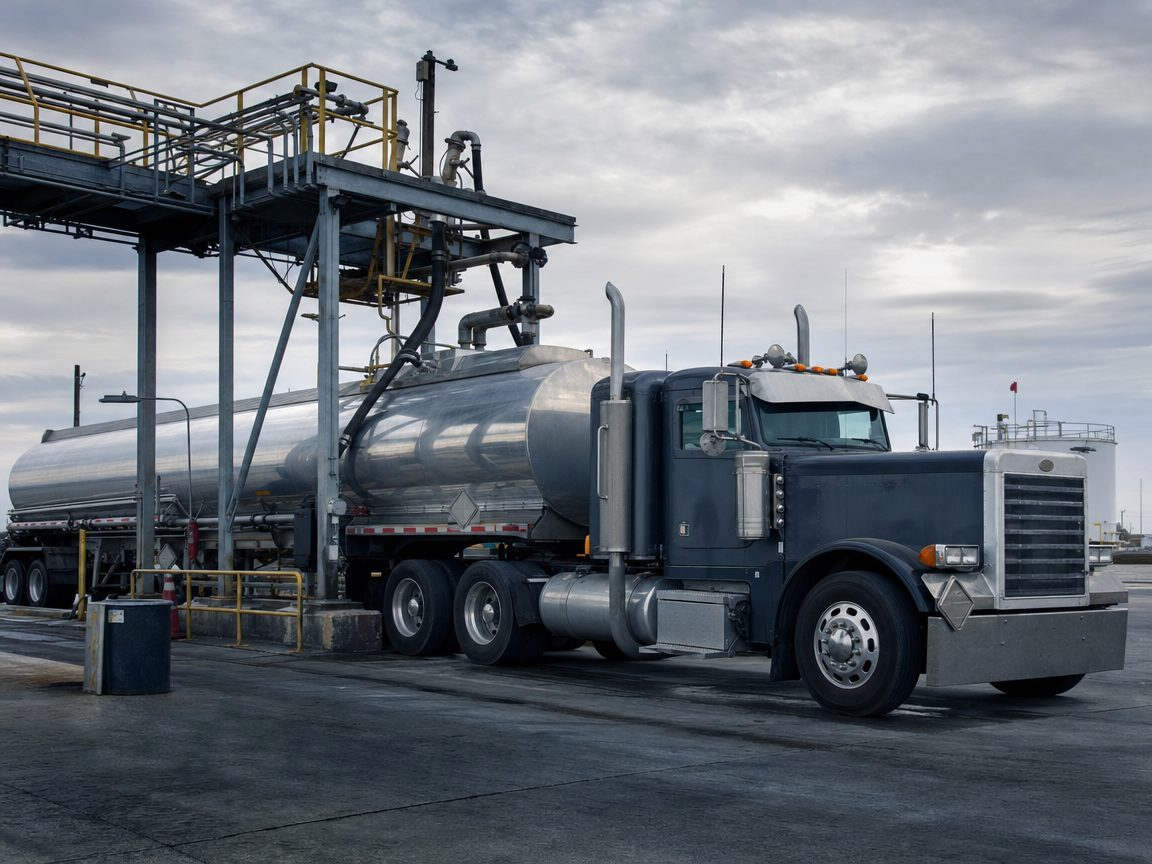
What the federal rules require
Two things decide your minimum: how heavy your truck is rated and exactly what material you're carrying. That rating, known as GVWR, is the heaviest your truck is allowed to weigh fully loaded.
A for-hire carrier is any business paid to move freight belonging to someone else. When a for-hire carrier moves nonhazardous freight between states with a GVWR of 10,001 lbs or higher, the floor is $750,000 in liability. Hazardous loads push that floor higher.
| Truck rating (GVWR) | Load type | Minimum liability |
|---|---|---|
| GVWR 10,001 lbs+ | Paid interstate hauling of nonhazardous goods | $750,000 |
| GVWR 10,001 lbs+ | Oil, hazardous waste, or any hazmat requiring placards | $1,000,000 |
| GVWR 10,001 lbs+ | Radioactive material, poison gas, explosives, or hazmat in bulk tanks | $5,000,000 |
| Under 10,001 lbs | Interstate bulk loads in Divisions 1.1 through 1.3, or bulk Division 2.3 in Hazard Zone A | $5,000,000 |
The $1,000,000 tier
If you run a for-hire truck with a GVWR of 10,001 lbs or higher, placarded hazmat, oil, and hazardous waste call for a minimum of $1,000,000. Other hazmat outside the $5,000,000 categories also falls in this tier.
Your route matters here. Once you cross a state line or a national border, the $1,000,000 rule covers any quantity of these materials. Stay inside 1 state, and it applies only to bulk shipments.
Which loads call for $5,000,000?
This highest level covers the most dangerous freight: explosives, poison gas, and radioactive material, along with hazardous substances moved in bulk tanks. It reaches both for-hire and private carriers, which means it counts even when the material belongs to your own company.
When the truck has a GVWR of 10,001 lbs or higher, federal rules also name these bulk materials. This tier holds whether you cross state lines or stay inside one:
- Division 1.1, 1.2, or 1.3 in bulk
- Division 2.3 in bulk, Hazard Zone A
- Division 6.1 in bulk, Packing Group I, Hazard Zone A
- Division 2.1 or 2.2 in bulk
Check the material's division and, where relevant, its packing group and hazard zone before deciding which limit applies.
Do trucks under 10,001 lbs still need hazmat coverage?
Yes, in certain cases. A smaller truck rated under 10,001 lbs also needs $5,000,000 if it carries bulk Division 1.1 to 1.3 material or bulk Division 2.3, Hazard Zone A, across state or national lines. This applies to for-hire and private carriers.
The MCS-90 form on your policy
A high limit on its own won't do. Your liability policy also needs an endorsement, meaning a form attached to a policy that changes or confirms its coverage. Form MCS-90 is the public liability endorsement used on motor carrier policies. Federal law requires it on your liability policy.
An MCS-90 isn't issued per truck. It attaches to your liability policy and extends to every vehicle on that policy that the federal rules reach.
Getting proof of coverage on file
Proof of your liability coverage goes to FMCSA, the federal agency that regulates trucking companies, and your insurer files it using Form BMC-91 or BMC-91X, though a BMC-82 bond is accepted instead. Timing counts when you apply for new operating authority. Once your application is published, the insurance company gets 20 days to file, or the application gets dismissed.
When all your hauling stays in one state, that state sets both the liability minimum and the filing requirement. The insurer usually submits this using a Form E.
Common questions
What does hazmat insurance cost?
None of the sources here list a hazmat price. As a reference point, hotshot truckers pay $896 a month on average for commercial auto insurance, which works out to $10,757 a year. Progressive Commercial puts national monthly truck averages from $734 up to $926.
Is cargo insurance required for hazmat loads?
For freight carriers, federal rules don't require cargo insurance. The exception is household goods movers, who do need it. Still, plenty of brokers ask for it anyway. Big names like C.H. Robinson and TQL, along with Amazon Relay and Uber Freight, each want $100,000 in cargo coverage and a $1,000,000 auto liability limit.
I'm leased on to a carrier. Is my own hazmat limit necessary?
As long as you're running under that carrier's dispatch, their filing covers you. For your own truck, you'd carry non-trucking liability, also called bobtail, along with physical damage coverage.
Sources
Related
Get your rig priced by an agent
Hotshot Insure does not sell insurance. An independent agent who places hotshot and small truck policies prices your rig by phone, or you can send your details.