
Tanker truck insurance
For tanker truck insurance, federal law says most tanker trucks need at least $750,000, $1,000,000 or $5,000,000 in liability coverage. Which one applies depends on what you haul and how heavy your truck is rated to be.
- For-hire non-hazardous freight at 10,001 lbs or more, crossing state lines: $750,000
- Oil plus listed hazardous materials: $1,000,000
- Bulk cargo tanks holding hazardous substances: $5,000,000
Public liability pays out if your truck hurts a person or wrecks their property. Which minimum you need rests on your truck's weight rating, meaning the heaviest loaded weight the manufacturer allows for that vehicle. You'll find that rating on a label attached to the truck. A personal auto policy typically does not cover business use, so any tanker you run for work calls for a commercial policy.
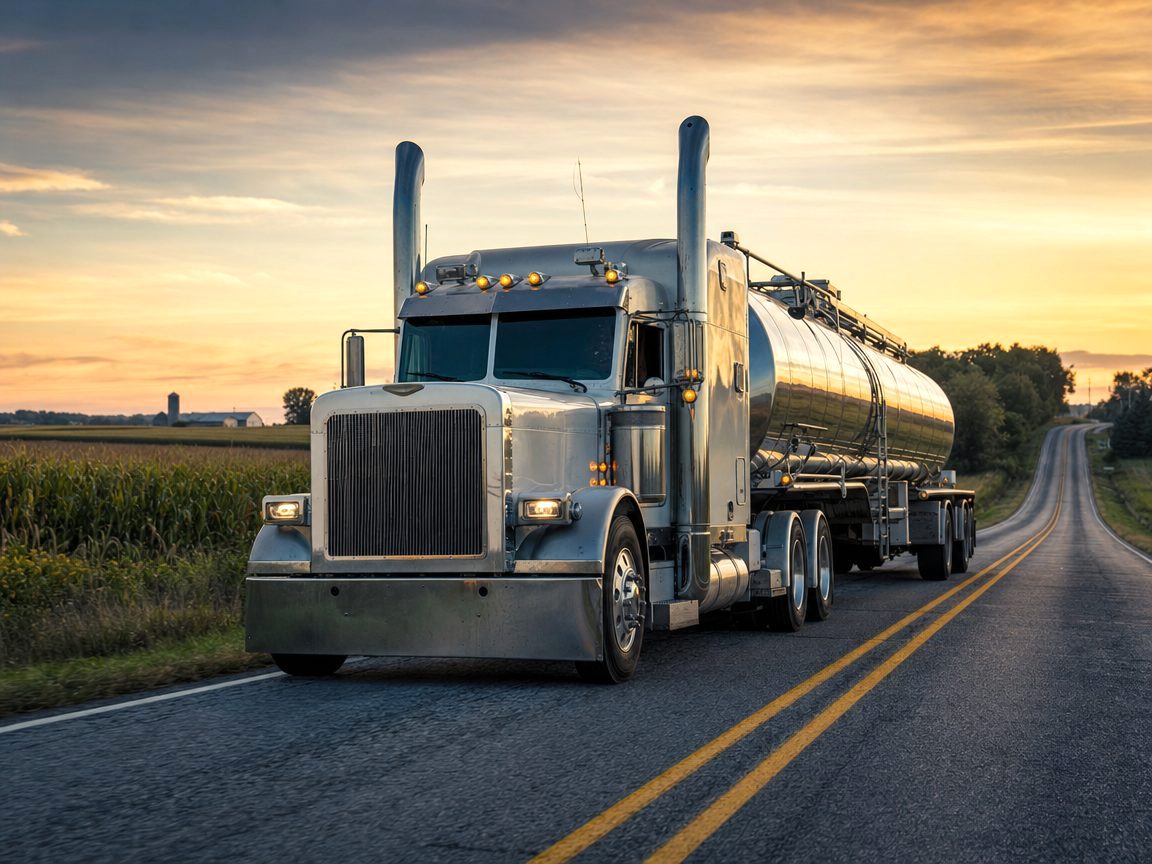
Tanker insurance minimums by cargo
What you haul drives the minimum, not just how big the tank is. These figures are set by 49 CFR 387.9, the federal regulation covering truck liability limits.
| What's being hauled | Who must carry it | Where the truck runs | Liability floor |
|---|---|---|---|
| Non-hazardous goods, vehicle rated at least 10,001 lbs | Carriers hauling for pay | Over state lines or into another country | $750,000 |
| Oil and the other hazardous materials on the list | Carriers of both kinds, for-hire and private | Any quantity over state lines; bulk only within one state | $1,000,000 |
| Hazardous substances carried in bulk cargo tanks, vehicle rated 10,001 lbs or more | Both for-hire and private carriers | Over state lines, into another country, or within one state | $5,000,000 |
| Bulk loads of Division 2.1 or 2.2 gases, vehicle rated 10,001 lbs or more | For-hire carriers and private carriers alike | The same routes as the previous row | $5,000,000 |
A private carrier is a company moving its own products rather than hauling freight for others in exchange for payment. With non-hazardous cargo, only carriers hauling for pay must meet the $750,000 requirement. When it comes to oil and bulk hazardous substances, those two tiers, $1,000,000 and $5,000,000, apply whether you're being paid to haul or moving your own product.
There's also a separate category in the rule for trucks under 10,001 lbs that travel across state lines. For fleets of only these lighter trucks hauling non-hazardous goods, the $300,000 figure comes from a suspended rule, so confirm the current requirement before relying on it.
Fuel tanker insurance
Oil sits in the $1,000,000 tier. That tier covers oil plus other listed hazardous materials that don't fall into the $5,000,000 groups, and it reaches both for-hire and private carriers.
Your routes decide when the rule kicks in:
- Over state lines or into another country: even a small amount of oil counts.
- Within a single state: the federal $1,000,000 rule covers bulk loads only.
When a load qualifies as a bulk cargo tank shipment of a hazardous substance, the floor jumps to $5,000,000. That higher limit holds even when you stay within your home state the whole time.
Big tanks and the $5,000,000 tier
Hazardous substances in bulk cargo tanks fall in the $5,000,000 tier. An older version of the rule, now suspended, used a tank size of over 3,500 gallons of water, so ask your agent which one applies to your tank. That same suspended list also places lighter freight trucks rated below 10,001 lbs hauling any quantity of Division 1.1, 1.2, and 1.3 cargo at $5,000,000.
Federal filing guidance likewise puts explosives, poison gas, and radioactive materials within the $5,000,000 tier, whether the carrier is for-hire or private.
Can you stack primary and excess coverage?
Yes. You can stack layers to reach your total. The first layer, the one that responds before any other policy, is what the rule names primary security.
An excess policy is the second layer, paying over the primary one until you hit the required minimum. Ask your agent how the two layers would add up for your cargo. The rule also states that carriers are never obligated to carry more than the federal minimums. Still, brokers and shippers may demand higher limits before handing you loads.
Filings you need in place before hauling
Proof of your liability limit gets sent to the federal agency by your insurer. That filing is submitted using Form BMC-91 or BMC-91X, or through a BMC-82 bond. The main steps run in this order:
- Get a USDOT number. Trucks rated 10,001 lbs or more in interstate service need one.
- Apply for operating authority; the fee is $300 per authority.
- Have your insurer submit the liability form. After the application is published, your insurer gets 20 days to send it in before the application gets dismissed.
- The 10-day protest period begins when your application is published, and your insurer's 20-day filing window also runs from publication.
- A process agent must submit Form BOC-3 for you. No one else is allowed to file it, and every state you operate in must be listed.
- Sign up for UCR. The 2027 fee is $55 for 0 to 2 power units.
On top of that, your liability policy must also carry the Form MCS-90 endorsement. Mexican carriers operating in the U.S. have to carry a copy of the endorsement in every vehicle they run.
Staying within one state, or leasing to a carrier
When all your hauling stays within one state, that state decides the liability minimum and what gets filed. Often the filing is a Form E from your insurer. Keep in mind the federal oil and bulk hazardous rules may still reach you.
When you lease your tanker to a carrier, that carrier's filing protects you while you run under its dispatch. Under the lease, that carrier must receive full possession of the truck, along with control over it and the right to use it. On your own, you still need non-trucking liability, also called bobtail, along with physical damage coverage for your truck.
Questions people often ask
What does a $1,000,000 liability policy run?
These truck insurance averages are not tanker-specific, so they cannot tell you what your tanker policy will cost. Hotshot truckers pay on average $896 monthly, adding up to $10,757 annually, for their commercial auto coverage. National monthly averages from Progressive Commercial for trucks ran anywhere from $734 a month for specialty truckers up to $926 for transport truckers.
Is $100,000 in cargo insurance required?
Freight carriers face no federal cargo insurance requirement. Household goods movers are the only ones with such a mandate. Even so, plenty of brokers want $100,000 in cargo coverage on top of $1,000,000 in auto liability. Among the brokers asking for it are C.H. Robinson and TQL, as well as Uber Freight and Amazon Relay.
Which companies insure tank trucks?
Tank trucks appear on Progressive Commercial's list of trucks it currently insures, and the company says it also helps its trucking customers handle state and federal paperwork.
Besides liability and cargo, do brokers want other coverage?
A few do. Amazon Relay, for one, also requires general liability of $1,000,000 for each occurrence with a $2,000,000 aggregate, plus trailer replacement coverage of $50,000 and employer liability of $100,000. For a rough benchmark, hotshot businesses average $32 a month for general liability.
Sources
- Financial responsibility, minimum levels (49 CFR 387.9)
- Insurance filing requirements (FMCSA)
- Security for the protection of the public: Minimum limits (49 CFR 387.303)
- Do I need a USDOT number? (FMCSA)
- What operating authority costs (FMCSA)
- How long an MC number takes (FMCSA)
- Form BOC-3, process agents (FMCSA)
- UCR fee brackets (UCR Plan)
Related
Get your rig priced by an agent
Hotshot Insure does not sell insurance. An independent agent who places hotshot and small truck policies prices your rig by phone, or you can send your details.