
Trucking insurance in California
The Department of Motor Vehicles issues your state operating permit only after you hold trucking insurance California with liability limits from $300,000 up to $5,000,000.
Monthly cost, national figures
$665 to $1,165 a month for an established hotshot with a clean record (Trucking Insurance Services)
$1,000 to $1,800 in the first two years of a new MC number (Trucker Path Insurance)
What moves the priceBroker ask
$1,000,000 of auto liability and $100,000 of cargo cover, more than the law asks
Broker limits tableOwn MC number
The OP-1 application costs $300, you name a BOC-3 process agent, UCR starts at $55 a year, and your insurer files the BMC-91X within 20 days of FMCSA Register publication.
New authority checklistTo activate your authority, Form MC 65 M must come from your insurer; most freight brokers also want auto liability of $1,000,000.
California intrastate trucking insurance requirements
Intrastate trucking means hauling that begins and finishes within the state, never crossing a border. Liability coverage must run from $300,000 up to $5,000,000 before the California DMV issues your Motor Carrier Permit. The amount depends on the property you haul and your vehicle type. A combined single limit is how this policy is written. The term combined single limit means one dollar pool covering bodily injuries and property damage alike after a crash.
The Department of Insurance lists renewal minimums for standard auto policies from January 1, 2025. They are $30,000 bodily injury per person, $60,000 each accident, and $15,000 property damage. State or federal agencies set extra commercial and fleet requirements that these basic auto limits won't meet.
To prove you carry commercial coverage, your insurer submits Form MC 65 M to the state. Since January 1, 2023, insurers have also sent commercial and fleet policy information electronically to the DMV registration database. To keep your registration from being suspended, you can file a Statement of Facts, Form REG 256, certifying that your insurance is on record with the DMV or Public Utilities Commission. Form MC 65 M doesn't come from a personal auto policy, which is why speaking with a commercial truck agent ensures your coverage is one the state accepts.
What trucks need a Motor Carrier Permit and a CA number?
For-hire operating means you are paid to haul someone else's property. For-hire work and larger trucks used for your own business both require a Motor Carrier Permit; you must apply before operations start. Gross vehicle weight rating means the most your truck and cargo can safely weigh, and the manufacturer prints it on the door sticker. Any of the following operations calls for a permit:
In-state carriers have needed 3 credentials since September 2016, per Caltrans: a federal USDOT number, a California Highway Patrol CA number, and a DMV Motor Carrier Permit. Send your application online or by mail, never to a DMV field office. You must attach a signed exemption or proof you carry workers' compensation insurance. The permit stays valid for 12 months from day one of your first application month. Fees depend on how many power units you have and whether your operation is private or for-hire work. To match your insurance certificate with the application, an agent handling truck filings daily can help you get your USDOT and CA numbers in order.
- Every vehicle paid to haul property, whatever its size, type, or weight.
- Any commercial vehicle whose gross vehicle weight rating is 10,001 pounds or more, in commercial or private use.
- Any vehicle or combination that carries hazardous materials.
- Any joined truck-trailer combination over 40 feet long (camp, utility, and trailer-coach pairings are exempt).
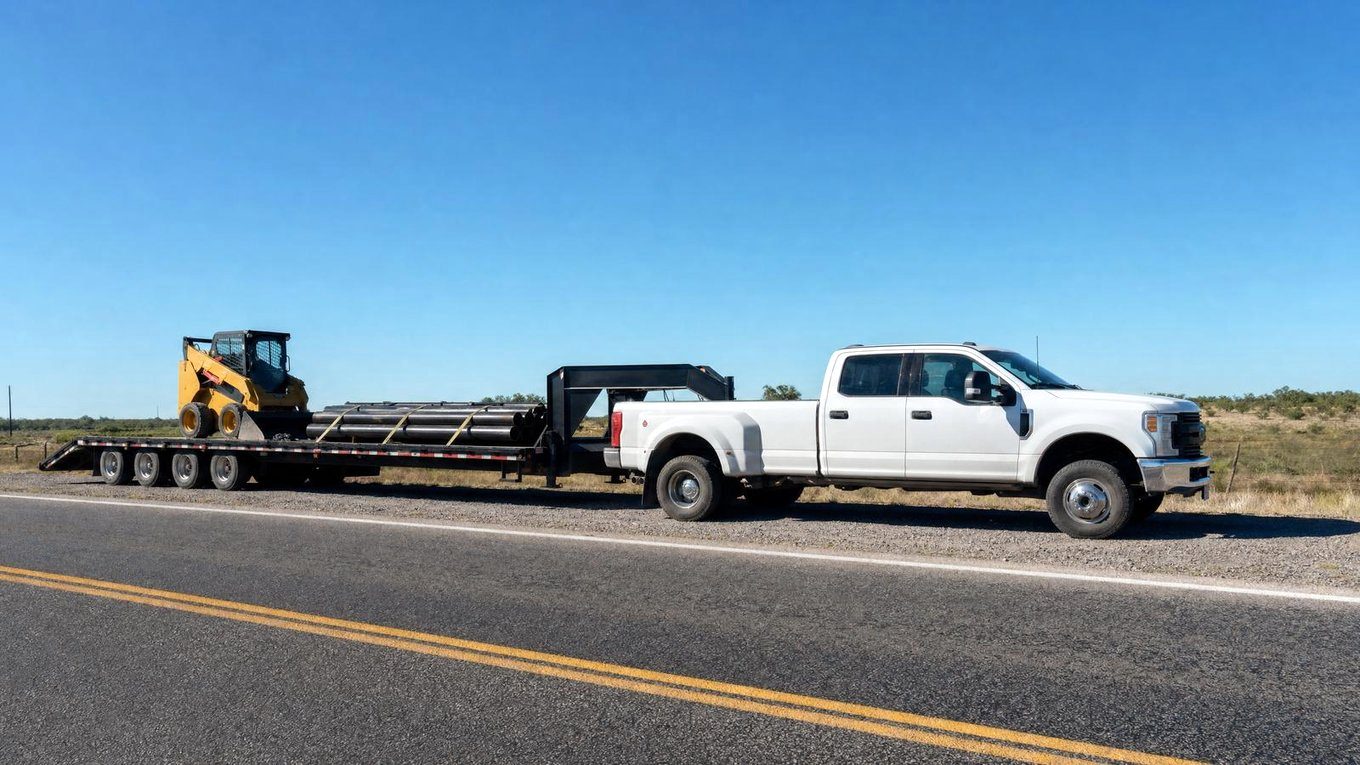
Limits for California commercial truck insurance and interstate hauls
After a state-line crossing, Federal Motor Carrier Safety Administration requirements cover you, and non-California truckers also need a USDOT number before entering California. Activating interstate authority takes a BMC-82 bond, Form BMC-91, or BMC-91X filed by your insurer.
Freight brokers like C.H. Robinson still request $1,000,000 for auto liability and $100,000 for cargo coverage, even when federal liability minimums set $750,000. Before you buy, a commercial truck agent can show prices for your legal minimum and a $1,000,000 broker limit, making the cost difference clear.
| Operation type | Minimum liability limit | Required filing form |
|---|---|---|
| California in-state permit (all property carriers) | $300,000 to $5,000,000 | Form MC 65 M |
| Interstate for-hire (fleet under 10,001 pounds) | $300,000 | Form BMC-91 or BMC-91X |
| Interstate for-hire (10,001 pounds or heavier, non-hazardous) | $750,000 | Form BMC-91 or BMC-91X |
| Interstate for-hire hazardous (oil, waste, placarded loads) | $1,000,000 | Form BMC-91 or BMC-91X |
| Poison gas, explosives, radioactive, or bulk tanks hauled interstate (for-hire or private) | $5,000,000 | Form BMC-91 or BMC-91X |
Safety and driver rules for California trucking insurance
Truck equipment and driver monitoring, which underwriters look at when setting up your policy, are required to operate legally on California highways:
When these safety steps are in place before you shop for coverage, a truck insurance agent can more easily place your policy with insurers that take on new ventures.
- Show the name or trademark of your operating company on each side of the vehicle, readable at 50 feet in daylight.
- Keep a fully charged fire extinguisher in a secure mount, plus 3 red emergency reflectors.
- Meet federal load securement rules and California's own intrastate hours-of-service limits, which are separate.
- Your company needs an Employer Pull Notice Requester Code when it employs endorsed Class C drivers or Class A, Class B drivers. It must also run federal alcohol and drug tests for drivers needing a hazardous-materials Class C credential or commercial Class A, Class B credentials.
Questions people ask
Does a moving company or a pickup truck need a Motor Carrier Permit?
A pickup is exempt when it's used just for personal, non-commercial trips, its weight rating stays under 11,500 pounds, it weighs under 8,001 pounds empty, and its bed measures 9 feet or less. Movers of household goods and passenger carriers are also exempt from a DMV permit, since their operating authority comes from the Public Utilities Commission.
Am I allowed to self-insure my California trucks or use a cash deposit instead?
You can meet basic vehicle financial responsibility with a surety bond or a cash deposit (the DMV lists $75,000, and the Department of Insurance lists $35,000), but that won't meet the commercial permit requirements. Self-insurance under a Motor Carrier Permit is allowed only under two conditions. Your name must be on the registration of at least 25 commercial vehicles, and the required liability limit must stay at or below $750,000.
Which forms should I file when I pause my trucking business or when I change my business entity?
A new CA number must be obtained from the California Highway Patrol after any business-entity change, and a new Motor Carrier Permit application must be filed too. When you stop operating, send Form MC 716 M or Form MC 134 M to the DMV so returning won't trigger delinquency fees.
Sources
- Motor Carrier Permits (dmv.ca.gov)
- Financial responsibility, minimum levels (49 CFR 387.9)
- California CDI: new year, new insurance changes (insurance.ca.gov)
- Auto Insurance Requirements (dmv.ca.gov)
- Identification (dot.ca.gov)
- Insurance filing requirements (FMCSA)
- Carrier Resources: FAQs (C.H. Robinson)
- Safety Requirements (dot.ca.gov)
Related
Insuring a truck in California
A trucking agent who places policies in California can quote it by phone, or you can send your details.