
Trucking insurance in Oregon
Motor carriers staying within Oregon must hold auto liability coverage of at least $750,000 plus $10,000 of cargo coverage under trucking insurance Oregon state rules.
Monthly cost, national figures
$665 to $1,165 a month for an established hotshot with a clean record (Trucking Insurance Services)
$1,000 to $1,800 in the first two years of a new MC number (Trucker Path Insurance)
What moves the priceBroker ask
$1,000,000 of auto liability and $100,000 of cargo cover, more than the law asks
Broker limits tableOwn MC number
The OP-1 application costs $300, you name a BOC-3 process agent, UCR starts at $55 a year, and your insurer files the BMC-91X within 20 days of FMCSA Register publication.
New authority checklistWithin 60 days after you register your truck and enroll in the weight-mile tax program, your agent files proof of these policies with the Oregon Department of Transportation Commerce and Compliance Division. An agent who handles commercial trucks daily can file those state forms on time for you, so your account avoids suspension.
Oregon intrastate trucking insurance requirements and filings
When you haul intrastate, you pick up freight and deliver it without crossing a state line at any point. Carriers that operate only in Oregon need a $750,000 auto liability minimum for each collision, as Oregon rules require. The policy is written as a combined single limit, one pool of money that pays for bodily injuries and property damage from a single accident.
For-hire hauling is when a customer pays you to move their goods instead of your own property. For-hire carriers in Class 1A, 1G, 1B, and 1C must hold cargo coverage of at least $10,000. They can file a letter of credit that is irrevocable instead (the state accepts one as a substitute for liability or cargo policies). Your agent files Form E for liability coverage and Form H for cargo with the ODOT Commerce and Compliance Division. This must happen within 60 days after you register the truck and enroll in the weight-mile tax. Form E and Form H don't come from the state. Your agent must already have these industry forms and know how to send them in before your operations get suspended.
State accounts, bonds, and permits for Oregon trucking insurance
You must set up an Oregon motor carrier account before policy filings can be linked to your business. This applies to trucks with a combined weight over 26,000 pounds and to for-hire hotshot trucks weighing 26,000 pounds or less. It also covers operations that run on more than 35 temporary passes within 12 months. A commercial vehicle over 26,000 pounds gets registered at the heaviest loaded weight it will operate at in the state that year.
Opening a new intrastate account means 3 state steps in addition to the filings for your policy. An agent who writes trucks can spare you paperwork delays, since your operating authority stays with the state until the tax deposit and Form E agree.
- Class 1A Permit: This covers intrastate for-hire hauling of commodities except household goods. It requires a $300 application fee, Form 9745, and liability coverage proof on file with ODOT.
- Surety bond or security deposit: New carriers must put up $2,000 for 1 vehicle, plus $375 apiece for vehicles 2 through 5. This holds whether they run under weight-mile tax enrollment, a temporary pass, or an ODOT plate.
- Weight-mile tax reporting: You can elect quarterly reporting and payment of weight-mile taxes. A report must still be filed even when the tax due is 0.
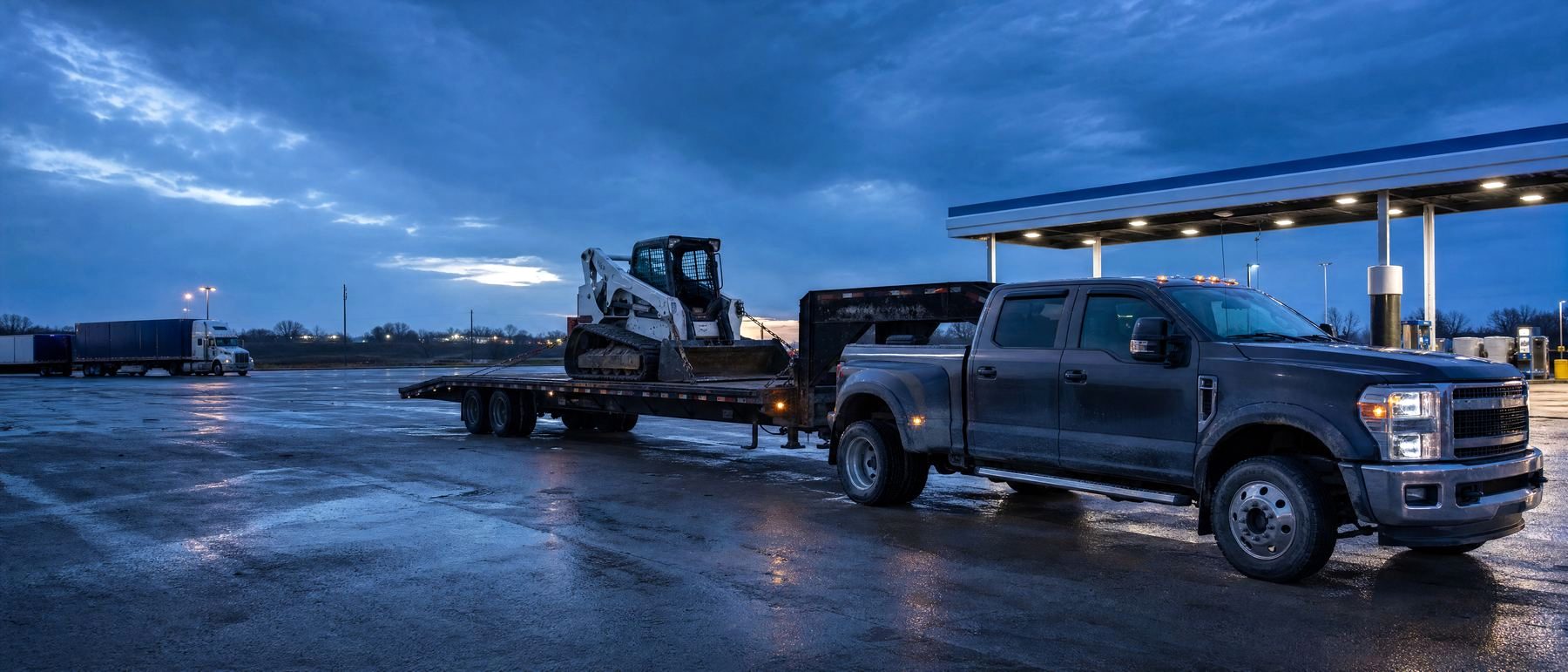
Do you need higher Oregon commercial truck insurance limits to cross state lines?
An active FMCSA insurance filing (made on Form BMC-91, Form BMC-91X, or a BMC-82 bond) still meets Oregon's intrastate filing requirement. That holds even though you fall under federal rules once you cross a state line. A vehicle over 10,000 pounds needs a USDOT number and annual Unified Carrier Registration fees, and interstate for-hire carriers need an MC number too. Switching later from interstate to intrastate-only work means you must file intrastate coverage, and the 30-day clock starts when you notify the state.
Federal financial responsibility minimums also apply to intrastate carriers that haul hazardous materials in certain vehicles. State or federal law may allow $750,000, but big freight brokers like C.H. Robinson want auto liability of $1,000,000 and cargo coverage of $100,000. An agent who focuses on trucking can quote the legal minimum as well as the broker standard, so booking loads can start right away.
| Operation or cargo type | Auto liability minimum | Cargo or filing requirement |
|---|---|---|
| Oregon intrastate for-hire carrier | $750,000 | Cargo of $10,000 on Form H; liability on Form E |
| Interstate for-hire with only vehicles under 10,001 lbs | $300,000 | Form BMC-91, BMC-91X, or BMC-82 bond |
| Interstate for-hire non-hazardous at 10,001 lbs or more | $750,000 | Form BMC-91, BMC-91X, or BMC-82 bond |
| Certain hazardous materials, oil, or hazardous waste | $1,000,000 | Form BMC-91, BMC-91X, or BMC-82 bond |
| Explosives, poison gas, radioactive, or bulk hazardous tanks | $5,000,000 | Form BMC-91, BMC-91X, or BMC-82 bond |
 C.H. Robinson freight broker standard | $1,000,000 | $100,000 in cargo liability |
Safety compliance, older diesel rules, and cab markings
A few more compliance steps beyond your policy filings are needed to get your truck legal on state roads. Every power unit needs identification under Oregon marking rules: your legal or trade name and the USDOT number, on each cab side. It must be clear at 50 feet in daylight while stopped. This does not apply to vehicles with combined weight at 26,000 pounds or less used only for intrastate private carriage.
Carriers running Oregon-based vehicles must also have drug and alcohol testing that meets federal rules. Carriers in Clackamas, Multnomah, and Washington counties also face a 2023 through 2029 restriction. Trucks with 1996-or-older diesel engines can't be registered unless retrofitted or exempted. Have a knowledgeable agent look at the engine year and insurance cost before you buy, which helps you avoid a rig that cannot be registered.
Questions people ask
How do motor carrier limits compare to Oregon DMV auto insurance minimums?
Registering a vehicle in Oregon always requires you to give an insurance policy number. For a basic driver, bodily injury coverage sits at $25,000 for each person and $50,000 for each crash. Property damage is $20,000, personal injury protection is $15,000, and uninsured motorist coverage runs $25,000 for each person and $50,000 for each crash. Those personal limits won't cover commercial freight. When you haul under an ODOT account, an agent has to write a $750,000 motor carrier policy.
If nonpayment leads to a cancelled Oregon trucking policy, what happens?
Before cancelling a policy for nonpayment, Oregon auto insurers must give you at least 10 days' notice. Your vehicles may not operate on Oregon highways once the required motor carrier insurance is cancelled. Talking with your agent ahead of a billing due date can help you adjust the policy before a cancellation takes your truck off the road.
If I only haul gravel or logs, can I get an Oregon cargo insurance waiver?
Yes, that rule can be waived. The state may drop the $10,000 cargo coverage requirement when you haul only commodities that can't suffer material damage or loss. Sand, rock, gravel, dirt, debris, cinders, ready-mix concrete, logs, ores, poles, and cut trees all qualify. After your commodity waiver is approved, your agent can file the Form E liability proof and leave out the Form H.
Sources
- Oregon insurance requirements (oregon.gov)
- Oregon administrative rules, division 3479 (secure.sos.state.or.us)
- Operating as a motor carrier in Oregon (oregon.gov)
- Oregon form 9075 (oregon.gov)
- Insurance filing requirements (FMCSA)
- Carrier Resources: FAQs (C.H. Robinson)
- Oregon truck cab marking rules (oregon.gov)
- Oregon DMV insurance rules (oregon.gov)
Related
Insuring a truck in Oregon
A trucking agent who places policies in Oregon can quote it by phone, or you can send your details.