
Trucking insurance in Connecticut
For trucking insurance Connecticut requires a minimum of $750,000 in liability coverage as soon as a truck working in-state is rated over 18,000 pounds.
Monthly cost, national figures
$665 to $1,165 a month for an established hotshot with a clean record (Trucking Insurance Services)
$1,000 to $1,800 in the first two years of a new MC number (Trucker Path Insurance)
What moves the priceBroker ask
$1,000,000 of auto liability and $100,000 of cargo cover, more than the law asks
Broker limits tableOwn MC number
The OP-1 application costs $300, you name a BOC-3 process agent, UCR starts at $55 a year, and your insurer files the BMC-91X within 20 days of FMCSA Register publication.
New authority checklistA lighter business vehicle that stays inside the state can register using state auto coverage from $25,000 up to $50,000. Most freight brokers still want $1,000,000. An agent who handles commercial truck insurance helps you fit your policy to your exact weight class ahead of your state filing.
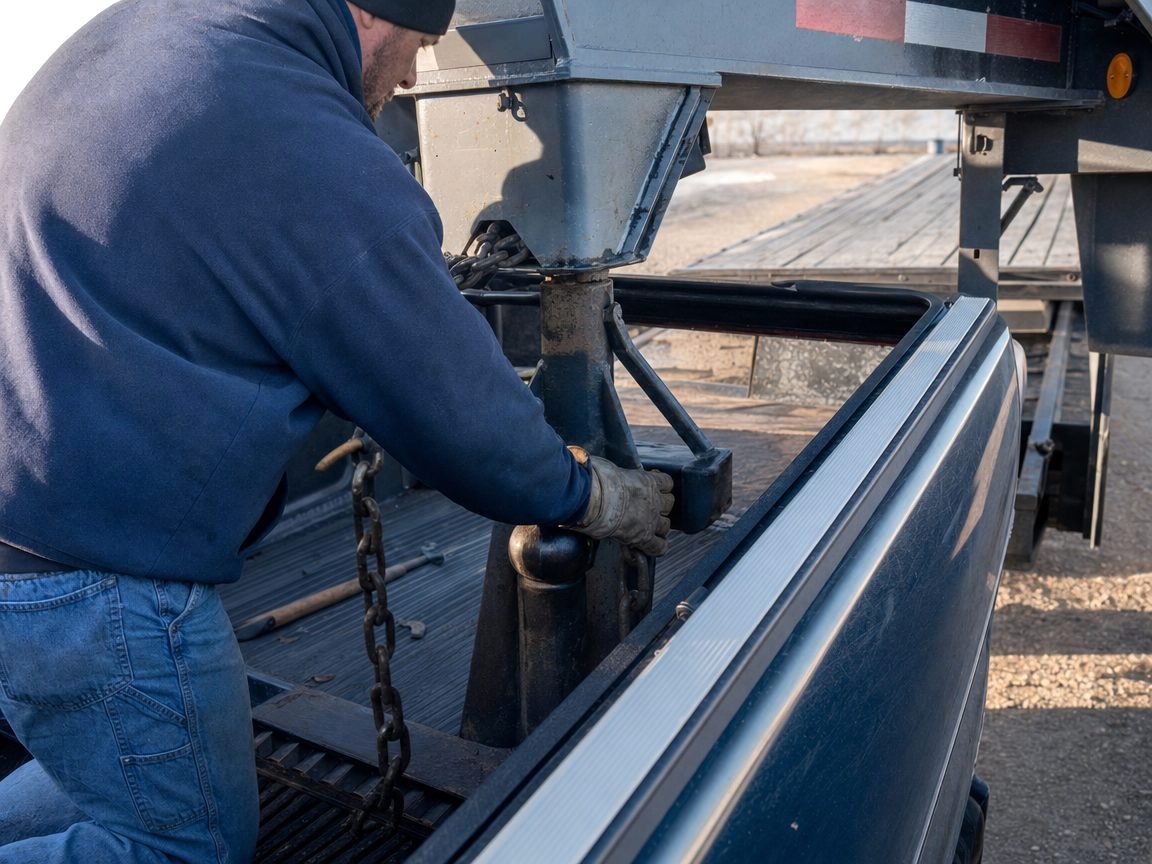
Connecticut intrastate trucking insurance requirements
If your vehicle picks up and delivers only within Connecticut borders, that's intrastate trucking. Federal financial responsibility rules apply to in-state trucks whose gross vehicle weight rating exceeds 18,000 pounds because the Department of Motor Vehicles commissioner adopted them under Connecticut law. The manufacturer sets the most a loaded truck can safely weigh, shown on your door-jamb label; that figure is the gross vehicle weight rating. Depending on vehicle type and cargo, a truck over 18,000 pounds must hold liability coverage of $750,000 to $5,000,000.
An intrastate Connecticut DOT number is also required for any vehicle used within the state at 18,001 pounds or more, by weight or rating. Hauling hazardous materials in amounts that call for placards triggers the same requirement at any weight. A placard is a diamond-shaped warning sign mounted outside the truck. In Connecticut, carriers running intrastate or interstate must obey the federal rules on motor carrier safety and on hazardous materials. Before you apply for your state number, an insurance agent who handles commercial trucks helps you choose the right limit.
Minimum limits for Connecticut commercial truck insurance
In Connecticut, a vehicle built or used to move merchandise, freight, or people for a business must be registered commercially. Because a personal auto policy usually leaves out business activities, even a light work truck has to be insured commercially. Say your vehicle stays in Connecticut and is rated no higher than 18,000 pounds. Then state auto statute requires bodily injury liability of at least $25,000 for each person and $50,000 for each accident. Property damage coverage of $25,000 per accident is required too.
A $50,000 combined single limit is also accepted by the Connecticut Insurance Department: 1 pool of money covering crash injuries and property damage. Uninsured and underinsured motorist coverage is required in every policy, with minimums of $25,000 for each person and $50,000 for each accident.
What shippers demand is often more than the legal minimums. Even with the state allowing $50,000 or $750,000, big brokers such as C.H. Robinson ask carriers to carry $1,000,000 of auto liability plus $100,000 of cargo liability, in our experience. A conversation with an agent familiar with freight contracts ensures the policy you buy won't be one brokers reject.
| Operation and weight rating | Cargo type | Minimum liability limit |
|---|---|---|
| Intrastate, 18,000 lbs or less | General business freight | $25,000/$50,000/$25,000 (or $50,000 combined) |
| Intrastate, over 18,000 lbs | General freight or regulated cargo | $750,000 to $5,000,000 |
| Interstate for-hire, under 10,001 lbs | Non-hazardous property | $300,000 |
| Interstate for-hire, 10,001 lbs or more | Non-hazardous property | $750,000 |
| Interstate for-hire, any weight | Oil, hazardous waste, or placarded loads | $1,000,000 |
| Interstate for-hire or private, any weight | Explosives, poison gas, radioactive, or bulk hazmat | $5,000,000 |
Filing Connecticut trucking insurance and state tax permits
Every year, carriers holding a DOT number must get their insurance proof to the DMV Insurance Compliance Unit. Your DOT number registration must also be updated every 24 months, and any change in your company details calls for an immediate update. Insurers in Connecticut don't have to alert the DMV after canceling a commercial auto liability policy. That means keeping your yearly proof up to date is your job.
Heavy multi-unit trucks with a gross weight at or above 26,000 pounds, in federal Classes 8 through 13, also need a Highway Use Fee Permit. That rule took effect January 1, 2023. A truck insurance agent can get the annual proof of coverage ready for the DMV while you set up your tax account.
- Per-mile rates: Weight and distance traveled in Connecticut set the fee. At 26,000 to 28,000 pounds the rate is 2.5 cents per mile, rising to 17.5 cents per mile above 80,000 pounds.
- Quarterly returns: By the last day of the month that follows a quarter, carriers need to submit and pay electronically via Department of Revenue Services myconneCT (even with 0 Connecticut miles).
- Late penalties: A late or incomplete return triggers a charge of 10% of the unpaid tax, or $50 if that's more. There's also 1% interest for each month or part of one.
Are federal filings required when you cross state lines?
Once a truck's weight rating, or the truck-and-trailer combination rating, goes past 10,000 pounds, crossing into another state brings federal rules into play. An interstate DOT number and a passed safety audit become mandatory at 10,001 pounds or more, or whenever you carry a placarded hazardous load. Federal liability rules set a $750,000 minimum for carriers hauling non-hazardous property between states for hire once weight reaches 10,001 pounds or higher.
A fleet made up entirely of vehicles below 10,001 pounds means a for-hire property carrier must hold $300,000 at minimum. Activating interstate authority requires your insurer to file Form BMC-91 or BMC-91X (a BMC-82 bond also works) with the Federal Motor Carrier Safety Administration. An insurance agent who files federal truck paperwork every day keeps your authority on track, because you cannot submit a BMC-91X on your own.
Questions people ask
What are the consequences of driving an uninsured, commercially registered truck in Connecticut?
Failing to carry the required coverage on a vehicle with commercial registration counts as a class C misdemeanor. The penalty can be a fine of as much as $500, a jail term of as long as 3 months, or both. A conviction for running the vehicle without security costs the owner a fine between $100 and $1,000. A 1st conviction brings a 1 month suspension from the DMV for the vehicle registration and the driver's license; later convictions bring 6 months.
In Connecticut, what fines apply for breaking the heavy truck insurance rules?
A 1st violation is an infraction for trucks covered by the state-adopted federal financial responsibility rules, and breaking an out-of-service order is an infraction too. A 2nd or later financial-responsibility violation may lead the DMV commissioner to set a civil penalty as high as $10,000 for each violation.
If my federal authority was revoked, can I still get a Connecticut intrastate DOT number?
No. Once a company is revoked as an interstate carrier, it can't operate as an intrastate carrier in Connecticut. You must fix the federal issue and wait for the Federal Motor Carrier Safety Administration to lift the revocation.
Sources
- Commercial Vehicle Insurance Requirements (cga.ct.gov)
- Auto Insurance (portal.ct.gov)
- Get or update a DOT number in Connecticut (portal.ct.gov)
- Highway Use Fee (portal.ct.gov)
- OLR report 2023-R-0090 on truck insurance (cga.ct.gov)
- Carrier Resources: FAQs (C.H. Robinson)
- Financial responsibility, minimum levels (49 CFR 387.9)
- Insurance filing requirements (FMCSA)
Related
Insuring a truck in Connecticut
A trucking agent who places policies in Connecticut can quote it by phone, or you can send your details.