
Trucking insurance in New York
For your business, the trucking insurance New York requires begins at $25,000 in bodily injury coverage to register with the state, and it climbs to $750,000 or more once you haul freight across state lines.
Monthly cost, national figures
$665 to $1,165 a month for an established hotshot with a clean record (Trucking Insurance Services)
$1,000 to $1,800 in the first two years of a new MC number (Trucker Path Insurance)
What moves the priceBroker ask
$1,000,000 of auto liability and $100,000 of cargo cover, more than the law asks
Broker limits tableOwn MC number
The OP-1 application costs $300, you name a BOC-3 process agent, UCR starts at $55 a year, and your insurer files the BMC-91X within 20 days of FMCSA Register publication.
New authority checklistOnly insurers authorized in New York can send filings that state agencies will accept. A commercial trucking agent helps you submit the correct forms the 1st time.
New York intrastate trucking insurance requirements
Intrastate hauling means your loads are picked up and delivered only inside New York, never across a state line. For-hire carriers are regulated by the New York State Department of Transportation, which also oversees their insurance and safety. Managing carrier credentials, along with the Unified Carrier Registration program, is the role of its registration office. The Motor Carrier Safety Assistance Program operates statewide under Motor Carrier Compliance Bureau management.
Operating authority means the state officially allows your business to carry someone else's goods for pay. With a NY.GOV ID, you submit your application online through the Carrier Certification System. For household goods, the department posts applications in its Weekly Bulletin for 30 days. The filing must come from an insurer approved by the New York State Insurance Department:
State filings to Albany aren't something every insurance company can handle. Before you buy, have a trucking agent confirm that your insurer can file exactly the forms your authority needs.
- Evidence of motor carrier liability insurance, filed on Form E.
- Evidence of cargo insurance, filed on Form H.
- Workers' compensation coverage proven with Form C-105.2, issued by a private insurer authorized by the state.
Keeping your New York trucking insurance active at the DMV
For New York registrations, the DMV won't take out-of-state coverage. Your vehicle must be registered within 180 days of when your insurance ID card takes effect. New York DMV rules set minimum liability at $10,000 for property damage per crash. For 1 person, bodily injury is $25,000 and death is $50,000; for 2 or more people, bodily injury is $50,000 and death is $100,000.
Vehicles from other states that operate in New York must also follow New York's financial responsibility law. With a lapse of 90 days or less, you may keep your plates and pay a civil penalty instead. The charge is $8 daily for the initial 30 days (a 25-day lapse, for example, costs $200). If a registration suspension goes beyond 90 days, your driving privileges are suspended too, and it takes a $50 termination fee to lift. Crash while uninsured and you face a fine from the court of up to $1,500, a $750 DMV civil penalty, and a revocation lasting at least 1 year. Your state ID cards and filings stay accurate with help from a trucking insurance agent, so a lapse never leaves your truck parked.
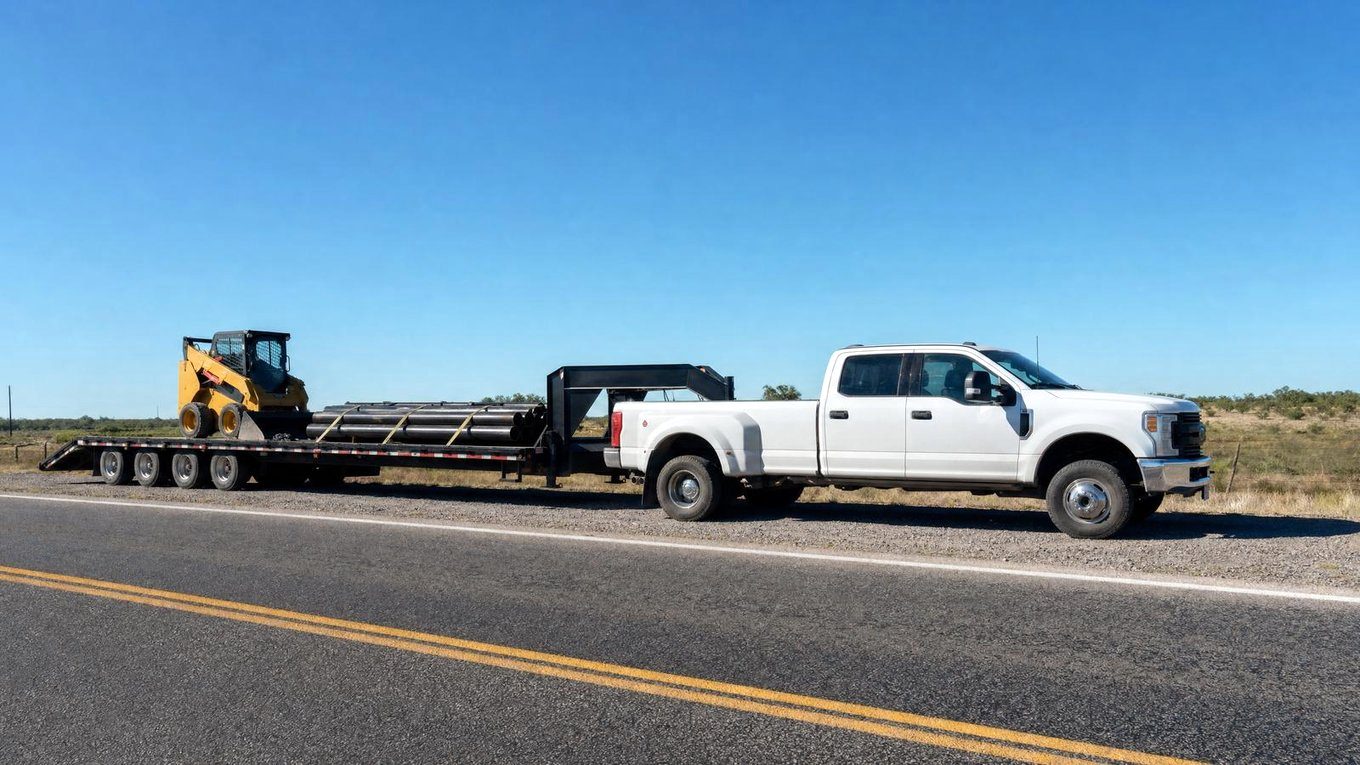
New York commercial truck insurance for interstate hauling
Once you cross a state line with for-hire freight, federal rules apply to you. Proof of liability goes to the Federal Motor Carrier Safety Administration from your insurer on Form BMC-91, Form BMC-91X, or a BMC-82 bond. To show federal regulators that your liability policy is active, your insurance company sends an electronic certificate: Form BMC-91X.
Federal rules give light fleets a $300,000 floor under 49 CFR 387.303, and they set $750,000 for heavier general freight trucks. Even so, most freight brokers want you to carry higher coverage before they give you loads.
Carriers are asked by brokers like C.H. Robinson for $1,000,000 of auto liability coverage and $100,000 of cargo liability. An agent writing trucks every day can quote the legal minimum plus the $1,000,000 limit brokers want, which means booking loads won't force a policy rework.
| Carrier and cargo type | Minimum federal liability |
|---|---|
| Property fleet for hire with only vehicles under 10,001 lbs | $300,000 |
| For-hire non-hazardous property carrier whose vehicle is rated 10,001 lbs or more | $750,000 |
| Carrier for hire moving oil, hazardous waste, or placarded hazardous materials | $1,000,000 |
| Carrier for hire or private carrier moving explosives, poison gas, radioactive materials, or hazardous substances in bulk | $5,000,000 |
What state permits and tax filings apply to you?
Displaying a USDOT number is required for any business truck or truck-and-trailer rig rated 10,001 pounds or more, even when operations stay within New York. NYC Business fleet rules require commercial vehicles over 10,000 pounds to register with USDOT (personal vehicles do not), and the state sets Unified Carrier Registration fees based on fleet size.
Public highways in New York also carry a mileage-based highway use tax. Add your truck, your trailer, and your heaviest load together to get gross weight. A tax certificate is required for any truck or tractor whose gross weight tops 18,000 pounds. The unloaded weight method also requires one for trucks over 8,000 pounds, and for tractors over 4,000 pounds unloaded. After you pick a weight method, you cannot switch it until the next year. Submit Form TMT-39 or apply through the OSCAR online system, log New York miles daily for every vehicle, and send paper returns on Form MT-903. Working with an experienced agent helps confirm your policy matches your registered weights.
Questions people ask
What does it cost to get an intrastate USDOT number in New York?
An intrastate USDOT number carries a $0 charge, but a valid credit card is still required for online registration. Since New York stopped processing new USDOT applications, the federal system handles them. You must complete your biennial record update every 2 years.
After receiving a USDOT number, how should my truck be marked?
Both sides of your vehicle must show the legal or trade name of your business, matching your USDOT registration. Your lettering needs to stand out against the vehicle color and stay readable from 50 feet away. A minimum height of 2 inches is recommended.
Does the New York highway use tax apply on the Thruway?
No, toll-paid stretches of the New York State Thruway are exempt from the highway use tax. Occasional New York operators can get a trip registration certificate rather than open a full account, place a decal, and file tax returns.
Sources
- Registration & Licensing (dot.ny.gov)
- Highway use tax (tax.ny.gov)
- Financial responsibility, minimum levels (49 CFR 387.9)
- Truck & Motor Carrier (dot.ny.gov)
- What New York requires you to insure (dmv.ny.gov)
- New York auto liability rules (dmv.ny.gov)
- Insurance filing requirements (FMCSA)
- Security for the protection of the public: Minimum limits (49 CFR 387.303)
Related
Insuring a truck in New York
A trucking agent who places policies in New York can quote it by phone, or you can send your details.