
Trucking insurance in Kentucky
A single-limit policy of at least $60,000 is what the county clerk wants for trucking insurance Kentucky accepts.
Monthly cost, national figures
$665 to $1,165 a month for an established hotshot with a clean record (Trucking Insurance Services)
$1,000 to $1,800 in the first two years of a new MC number (Trucker Path Insurance)
What moves the priceBroker ask
$1,000,000 of auto liability and $100,000 of cargo cover, more than the law asks
Broker limits tableOwn MC number
The OP-1 application costs $300, you name a BOC-3 process agent, UCR starts at $55 a year, and your insurer files the BMC-91X within 20 days of FMCSA Register publication.
New authority checklistHaul for pay across state lines, and federal rules set liability coverage at $300,000 to $5,000,000. Gross weight, cargo, and drop locations determine the exact filings you need.
Kentucky intrastate trucking insurance requirements
Hauling intrastate means picking up and delivering the same cargo within Kentucky, with no state line crossed. Any business that gets paid to haul someone else's property counts as a for-hire carrier. Carriers paid to haul within the state (intrastate or interstate alike) must purchase a Kentucky Intrastate Authority Certificate. To verify which credentials your operation needs, you can get in touch with the Kentucky Division of Motor Carriers.
A Kentucky-based carrier working only inside the state owes an application fee and another $10 for every vehicle in the fleet. If you haul both inside and outside the state, a $25 application fee is required (whatever your base state). For-hire carriers from out of state that do both kinds of hauling must also fill out Section 6 and file Form E. Your insurance company sends Form E straight to the state as official proof of coverage, by mail or via the National Online Registries website.
Send Form E rather than an insurance card, since the Division of Motor Carriers won't take the card; the state finishes applications within 7 to 14 working days of receipt. Because an agent who writes trucks daily can get your insurer to file Form E electronically, working with one keeps your paperwork moving.
County clerk rules for Kentucky commercial truck insurance
The county clerk requires proof of insurance with a commercial designation when you register a commercial vehicle. Kentucky mandatory insurance rules set the base state liability minimums: bodily injury, $25,000 per person; everyone in 1 accident, $50,000; property damage, $25,000. A $60,000 single-limit policy works in place of split limits, too.
At registration time, Kentucky won't take coverage placed with surplus lines carriers, whether it's commercial or personal auto liability. A surplus lines insurer is a specialty company that the state guaranty fund doesn't back. Before putting down a policy deposit, we always suggest consulting a commercial truck insurance agent; the right agent can arrange coverage with a standard insurer approved by the county clerk.
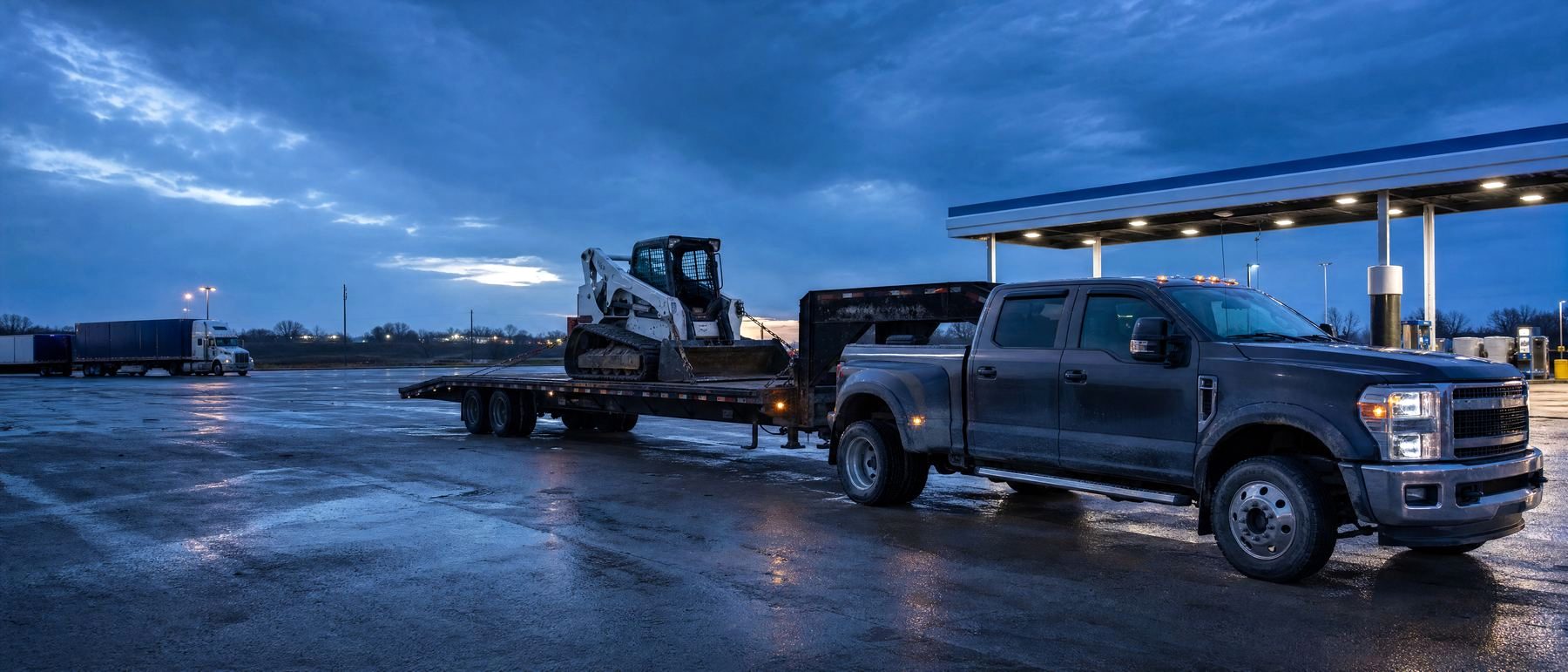
Credentials and weight taxes by truck size
A USDOT number is required for any vehicle used in commerce rated at 10,001 pounds or more gross weight. Past 26,000 pounds, or with 3 or more axles on the truck, Kentucky adds credentials for fuel and registration, and they depend on where you drive:
- Above 26,000 pounds, or running 3 or more axles, while staying inside Kentucky: reporting fuel use tax calls for a Kentucky Intrastate Tax License (the KIT license).
- Crossing state lines above 26,000 pounds or on 3 or more axles: fuel tax means an IFTA license, and IRP filing is required of Kentucky-based interstate carriers working in 2 or more member jurisdictions.
- At 60,000 pounds or heavier: any carrier past 59,999 pounds on Kentucky roads owes Kentucky Weight Distance Tax and must carry a KYU number (the Kentucky Highway Use License). Getting a KYU number costs $0, but you still owe the quarterly mileage tax and IFTA too.
What are the federal limits for Kentucky trucking insurance?
Crossing a state line to haul for-hire means federal rules replace state minimums. To activate your interstate authority, your insurer must submit Form BMC-91, Form BMC-91X, or a BMC-82 bond to the Federal Motor Carrier Safety Administration. Vehicle weight rating and what you haul set the liability minimum you're required to carry.
| Carrier operation and cargo | Federal liability minimum | Requirement source |
|---|---|---|
| For-hire fleet hauling non-hazardous property, all vehicles under 10,001 lbs | $300,000 | 49 CFR 387.303 |
| For-hire hauling of non-hazardous property in vehicles rated at least 10,001 lbs | $750,000 | 49 CFR 387.9 |
| For-hire carriers hauling placarded hazardous materials, oil, or hazardous waste | $1,000,000 | FMCSA insurance rules |
| Private and for-hire carriers of bulk hazardous substances, explosives, poison gas, or radioactive materials | $5,000,000 | FMCSA insurance rules |
Meeting the coverage standards freight brokers set
Freight brokers often want higher limits before you're able to haul their loads, even though federal requirements ask for only $750,000 on file, and $300,000 for lighter fleets below 10,001 pounds.
As one example, C.H. Robinson asks carriers for auto liability of $1,000,000 and cargo liability of $100,000. Talking with a trucking-policy agent helps you line up limits and filings with the brokers you'd like to haul for.
Questions people ask
If my Kentucky truck insurance lapses, what happens?
Kentucky imposes a $500 to $1,000 fine, as much as 90 days in jail, or both, for driving without the required coverage. You'll also owe a $40 reinstatement fee if a lapse cancels your vehicle registration.
Once I bring a truck into Kentucky, how long do I have to register it?
You must register a vehicle within 15 days of bringing it into Kentucky. When you visit the county clerk, take proof of coverage from an accepted insurer that shows a commercial designation.
Is a USDOT number required for farm-plated trucks in Kentucky?
An intrastate farm-plated vehicle needs a USDOT number only if it's over 26,000 pounds in weight. The 10,001-pound rule doesn't apply to farm-plated trucks of 26,000 pounds or less that stay inside Kentucky.
Sources
- Mandatory Insurance (drive.ky.gov)
- Commercial Motor Vehicle Credentials (drive.ky.gov)
- Financial responsibility, minimum levels (49 CFR 387.9)
- Motor Carriers (drive.ky.gov)
- Division of Motor Carriers profile (kentucky.gov)
- Insurance filing requirements (FMCSA)
- Security for the protection of the public: Minimum limits (49 CFR 387.303)
- Carrier Resources: FAQs (C.H. Robinson)
Related
Insuring a truck in Kentucky
A trucking agent who places policies in Kentucky can quote it by phone, or you can send your details.