
Trucking insurance in Oklahoma
A state carrier permit calls for trucking insurance Oklahoma will approve, with liability coverage from $300,000 up to $750,000 for most non-hazardous freight.
Monthly cost, national figures
$665 to $1,165 a month for an established hotshot with a clean record (Trucking Insurance Services)
$1,000 to $1,800 in the first two years of a new MC number (Trucker Path Insurance)
What moves the priceBroker ask
$1,000,000 of auto liability and $100,000 of cargo cover, more than the law asks
Broker limits tableOwn MC number
The OP-1 application costs $300, you name a BOC-3 process agent, UCR starts at $55 a year, and your insurer files the BMC-91X within 20 days of FMCSA Register publication.
New authority checklistBefore you haul within state lines, proof of that policy must be filed by your insurer with the Oklahoma Corporation Commission. An agent who handles commercial truck insurance helps you choose the correct coverage limit and keeps state filings moving so approval isn't delayed.
Oklahoma intrastate trucking insurance requirements
When you pick up and drop off loads without ever leaving Oklahoma, that's intrastate hauling. Haul property for pay, or drive a heavy company truck, and the Oklahoma Corporation Commission regulates you. A personal car is different: it requires only Oklahoma Insurance Department 25/50/25 as its auto liability limits. Each commercial requirement from the commission is a combined single limit. That means 1 total dollar pool covering bodily injury as well as property damage from a crash.
The limit you must carry depends on the truck's weight rating and the cargo in your trailer. It also depends on whether paying customers hire you or you move your own company's goods. In plain terms, a deleterious substance is a harmful liquid, oilfield salt water for example; it can damage soil or water and needs higher coverage. The top liability limit applies when your TDF 1 application shows more than 1 operating category. Going over your cargo categories with an agent who handles trucking insurance beforehand prevents costly filing mistakes.
| Operation and cargo type | Vehicle weight | Minimum liability limit |
|---|---|---|
| For-hire property carrier | Under 10,000 lbs | $300,000 |
| For-hire restricted property (ordinary livestock, unprocessed forestry or farm products, sand, rock, gravel, road-building materials) | 10,000 lbs or more | $350,000 |
| Private carrier hauling own property | Over 26,000 lbs | $350,000 |
| For-hire general (unrestricted) property | 10,000 lbs or more | $750,000 |
| Non-hazardous deleterious substances | Any weight | $750,000 |
| Intrastate household goods carrier | Any weight | $750,000 (plus $5,000 cargo per vehicle) |
Filing your Oklahoma trucking insurance and TDF 1 permit
Hauling for hire anywhere in the state first takes an Intrastate For-Hire Motor Carrier License issued by the Oklahoma Corporation Commission. Your permit won't be activated by an insurance cab card alone. Form E must go straight from your insurance company to the commission; this official certificate shows that your liability policy is active.
An insurance agent who handles truck filings regularly can transmit your Form E right when the application is filed, keeping your start date on track.
- You need an intrastate USDOT number under Oklahoma Department of Public Safety rules when your vehicle requires a commercial driver's license. That includes Class A combinations weighing at least 26,001 lbs and pulling a unit above 10,000 lbs. If the number has not been issued, send a completed MCS-150 form along with your application.
- File the TDF 1 form and pay the $100 filing fee. Keep a Chapter 30 rule book current for your operation.
- Each vehicle's identification stamp costs $7, and every truck must carry a stamped copy of the license.
- Your for-hire license needs renewal once 1 year passes (private licenses last 1, 2, or 3 years per renewal), and every $7 vehicle stamp must be renewed annually.
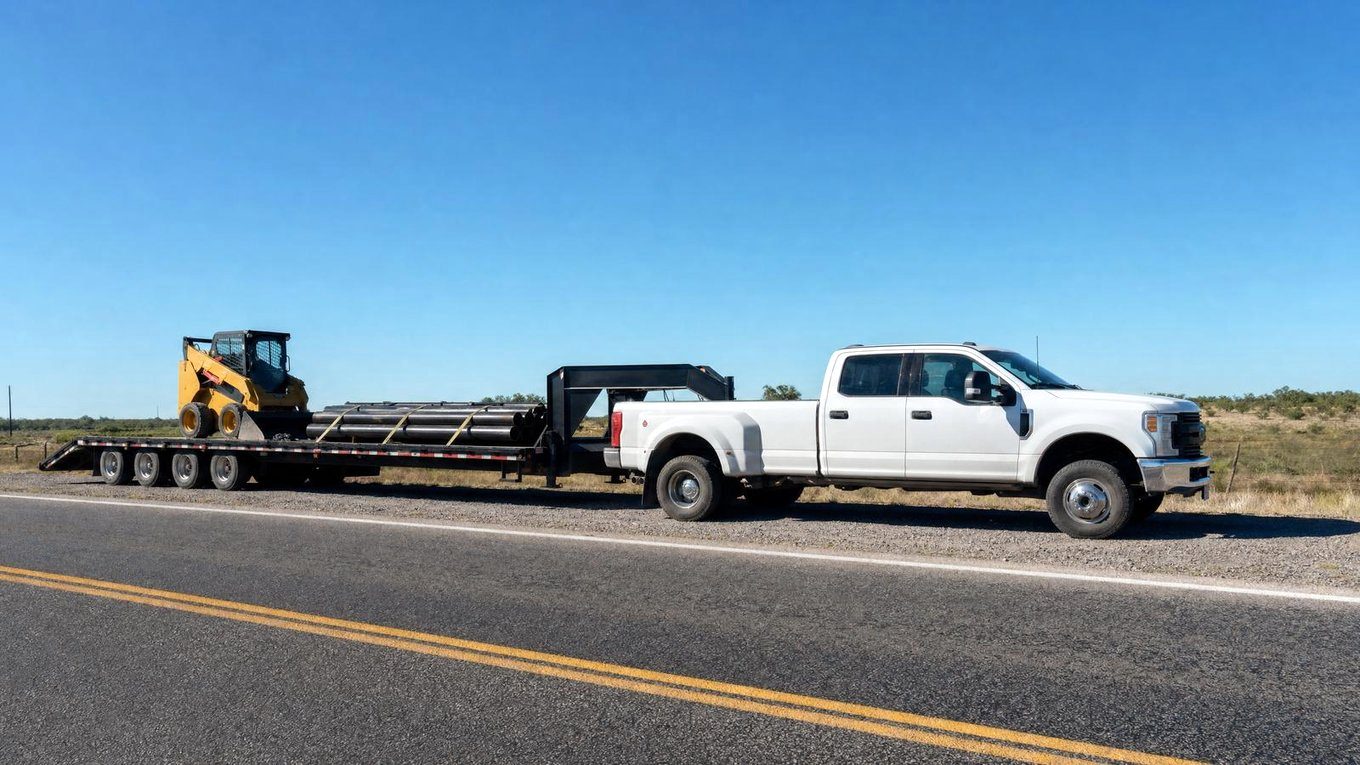
Which loads need special Oklahoma commercial truck insurance?
A separate certificate, not the standard freight license, is required when you move household goods within the state. Three things are required: an MCF 1 application costing $350 to file, liability coverage of $750,000 submitted on Form E or Form G, and cargo insurance of $5,000 per vehicle submitted on Form H or Form J. If you operate as a private carrier with your own property, the Intrastate Private Motor Carrier License is needed only for vehicles over 26,000 lbs, and that license never allows hauling for hire.
Federal safety regulations apply to any truck over 26,000 lbs, even when staying inside Oklahoma. They also cover intrastate carriers hauling placarded amounts of hazardous materials. Extra state permits are also needed to haul hazardous waste or deleterious substances. Getting the right filings to the state is easier with a commercial truck insurance agent, because each cargo class has its own state forms.
Hauling across state lines and meeting broker minimums
Running local loads inside Oklahoma does not change this: hauling across a state border means you must register as an interstate carrier. A commercial vehicle rated 10,001 lbs or more needs an interstate USDOT number. Registration under the Unified Carrier Registration program is also required. No Oklahoma Intrastate For-Hire license renewal is needed from carriers operating in interstate commerce. Federal liability proof comes from their insurers on FMCSA Form BMC-91 or BMC-91X (or a BMC-82 bond).
A fleet that runs only vehicles under 10,001 lbs starts with a federal liability minimum of $300,000. Trucks rated at least 10,001 lbs that carry general property need $750,000. A $5,000,000 minimum applies to bulk hazardous substances, explosives, poison gas, and radioactive materials. Oil, hazardous waste, or placarded hazmat need $1,000,000. Major freight brokers such as C.H. Robinson want auto liability of $1,000,000 plus cargo coverage of $100,000 before any load is booked. So a trucking insurance agent can weigh the state minimum against a policy brokers will accept.
Questions people ask
Does an Oklahoma truck policy have to include uninsured motorist coverage?
No, Oklahoma doesn't require uninsured motorist coverage on your policy. Still, state insurance rules make you reject it in writing when you don't want it on your policy.
Could an Oklahoma fleet self-insure rather than buy auto coverage?
Fleets of 25 or more vehicles may obtain a Department of Public Safety self-insurance certificate under general auto financial-responsibility rules. A certificate showing at least $75,000 on deposit, as cash or as a certificate of deposit, is also accepted. Even so, carriers under the Oklahoma Corporation Commission, for-hire and private alike, must still satisfy commercial filing rules.
If my insurance limit changes or my Oklahoma authority is upgraded, what filing is needed?
A new liability insurance filing must go to the Oklahoma Corporation Commission from your insurer after any change in your liability limit. When you upgrade an intrastate license for new operations, a TDF1 Upgrade Application and $100 fee are also due.
Sources
- Intrastate Licenses for For-Hire Motor Carriers (oklahoma.gov)
- Oklahoma OCC form TDF1 (public.occ.ok.gov)
- Oklahoma auto insurance myths (oid.ok.gov)
- U.S. DOT Number (oklahoma.gov)
- Oklahoma OCC form MCF1 (public.occ.ok.gov)
- Intrastate Licenses for Private Motor Carriers (oklahoma.gov)
- Insurance filing requirements (FMCSA)
- Security for the protection of the public: Minimum limits (49 CFR 387.303)
Related
Insuring a truck in Oklahoma
A trucking agent who places policies in Oklahoma can quote it by phone, or you can send your details.